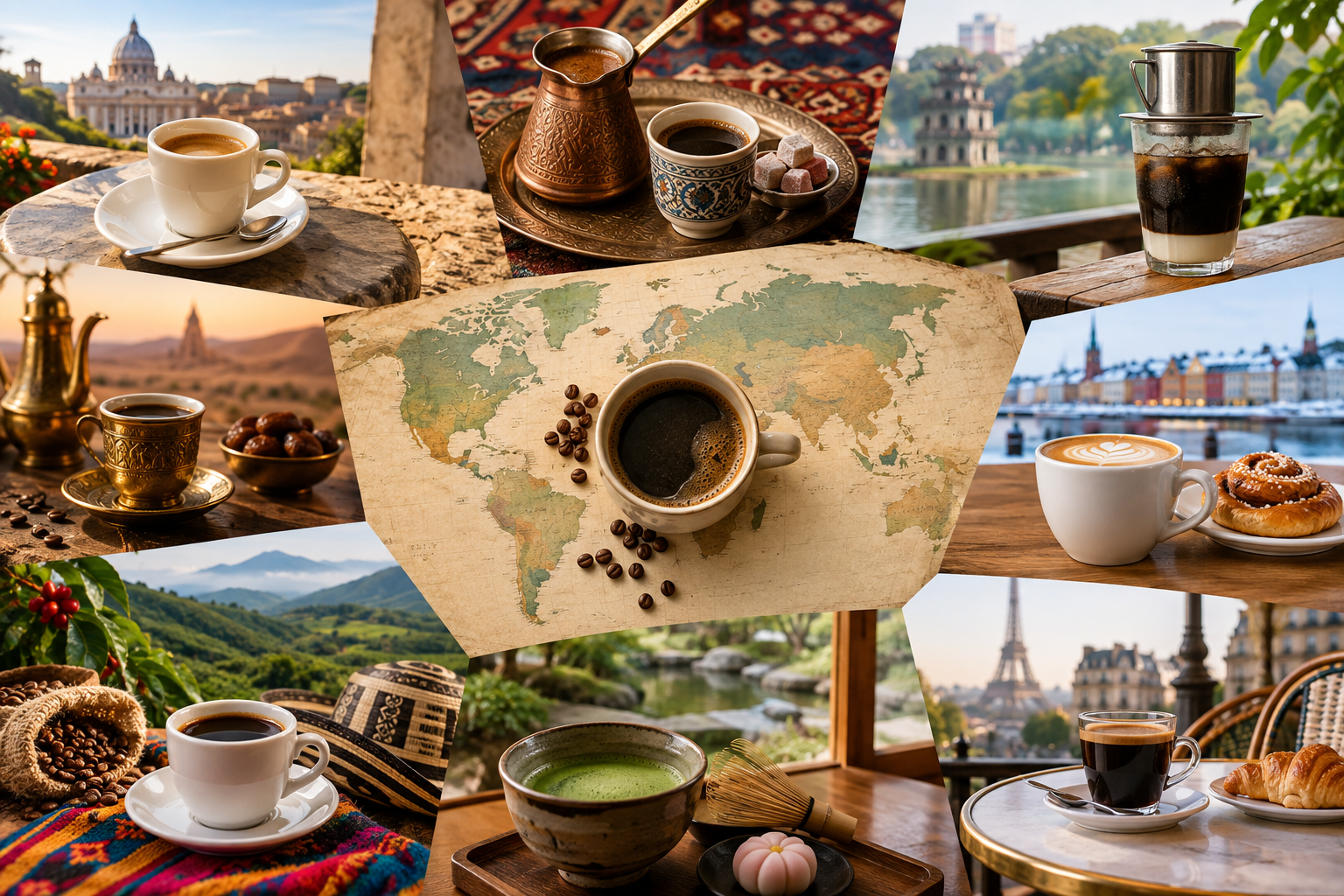
In Naples, a man walks into a bar, says one word to the barista and drinks his espresso standing up. Ninety seconds later he is back on the street. At the same moment in Helsinki, an office worker sits down with a big mug of light filter coffee. It is her second coffee break of the day, and nobody in the office thinks she is lazy.
The two people are drinking the same plant. Almost nothing else is the same. The world drinks around 2.25 billion cups of coffee every day, but every country has built its own rules around those cups: how long you sit, who pays, when you can order milk, and what you are supposed to talk about. The coffee is chemistry. The rules are culture — and they tell you what each country thinks time is for.
Ethiopia: the country where coffee is a ceremony
Coffee did not begin in Italy or Brazil. It began in Ethiopia, the home of the arabica plant. The famous legend says that a goat herder called Kaldi noticed that his goats could not sleep after eating red berries from a wild bush. Historians cannot prove the story, but they agree that Ethiopia is where people first used the beans.
Ethiopians still drink coffee in a way that would shock a tourist in a hurry. The ceremony, called buna, is usually led by a woman of the house. She roasts green beans in a flat pan over coals, in front of her guests, and carries the hot pan around so that everyone can smell the smoke. Then she crushes the beans by hand with a mortar and brews them in a round clay pot called a jebena. Incense burns while she works.
The coffee is served in three rounds, and each round has a name. The first, abol, is the strongest. The second, tona, is weaker. The third, baraka, means “blessing”, and it is light enough for children. Popcorn is often passed around too. The whole ceremony can take more than an hour, and in many homes it happens more than once a day. Ethiopia also drinks around half of the coffee it grows, instead of exporting all of it.
Turkey: a cup that is remembered for forty years
When coffee travelled north from Yemen, it met the Ottoman Empire, and the empire turned drinking it into an art. Turkish coffee is ground to a powder, not just broken into pieces. The powder is boiled slowly in a small pot called a cezve, taken off the heat when the foam rises, and poured into a tiny cup with the grounds still inside. A glass of water is always served with it.
Because the grounds stay in the cup, a second tradition grew around them. When you finish, you turn the cup upside down on the saucer, wait for it to cool, and a friend “reads” the shapes inside. This fortune telling is a game for most people today, but almost everyone knows how it works.
In Ottoman Istanbul, coffee houses became so popular and so political that rulers tried to close them more than once. The tradition survived, and in 2013 UNESCO put Turkish coffee culture on its list of the intangible cultural heritage of humanity. Two years later, in 2015, Arabic coffee joined the same list. In the Gulf countries, the coffee is lighter, often flavoured with cardamom, and the oldest or most important guest is always served first. Refusing a cup is close to refusing friendship.
A Turkish proverb says that one cup of coffee is remembered for forty years.
Vienna: renting a chair for the price of a coffee
Coffee arrived in Vienna at the end of the 17th century, soon after the Ottoman army left the city in 1683. Romantic stories say that a soldier found sacks of beans and opened the first café; historians usually name Johannes Diodato, an Armenian merchant, as the real pioneer. What matters more is what the Viennese did next. In 1720, a café on the Graben started offering newspapers to its customers, and the idea spread fast. By the 1910s, Vienna had about 600 coffee houses.
The Viennese coffee house is not a place to drink quickly. It has marble tables, wooden Thonet chairs, newspapers on sticks, and waiters who do not hurry you. Writers such as Stefan Zweig worked there for hours, and so did Freud and Trotsky. Every coffee still comes with a small glass of water, which is a quiet way of saying: stay as long as you like.
In 2011, Viennese coffee house culture was added to Austria’s national inventory of intangible cultural heritage. The official description explains the whole idea in one sentence:
time and space are consumed, but only the coffee is found on the bill
Italy: ninety seconds at the bar
Italy took the opposite road. Italians drink about six billion cups a year, and most of them are drunk standing up. An espresso at the bar costs around €1.20 and a cappuccino around €1.50, which is cheap for Western Europe. The price is low partly because the customer does not stay: you order, you drink, you leave, and the next person takes your place at the counter.
There is a second price, though. If you sit down at a table, the bar can legally charge you more for exactly the same coffee, sometimes double. Prices must be displayed, and this is taken seriously. In 2022, a café in Florence was fined €1,000 after a customer called the police — not because €2 was too much for an espresso, but because the price list was not on show.
Foreigners are often surprised by the milk rule: Italians drink cappuccino in the morning, usually before 11 o’clock, and almost never after a meal. No law says this, and a barista will still make you one at three in the afternoon. It is simply a habit, connected to the old idea that a lot of milk is heavy after eating. Naples has also given the world a kinder habit: the caffè sospeso, or “suspended coffee”. You pay for two cups and drink one. The other waits, already paid for, for someone who cannot afford it.
The Nordic countries: coffee as a scheduled break
If speed is the Italian idea, quantity is the Nordic one. Finland is usually at the top of the world rankings, with about 12 kilograms of coffee per person per year — roughly four cups a day for every adult. Finns mostly drink light-roasted filter coffee, not espresso, and most of it is made at home or at work rather than bought in a café.
The rankings hide one strange detail. Luxembourg sometimes appears above Finland, but not because its people drink more. Luxembourg is small, and many drivers from neighbouring countries buy coffee there, so the numbers are divided by too few people.
In Sweden, the break itself has a name: fika. It usually happens twice during a working day, in the middle of the morning and in the middle of the afternoon, and it comes with something sweet, most often a cinnamon bun. The important part is social, not liquid. You are expected to stop working, sit down with colleagues and talk about something other than work. Many Swedish workplaces build fika into the day, and skipping it too often looks unfriendly rather than hard-working. Finland has the same habit under a different name, kahvitauko, and coffee breaks are written into many collective agreements between employers and unions.
Vietnam: coffee you eat with a spoon
The French brought coffee plants to Vietnam in 1857. Today the country is the second biggest producer in the world after Brazil, and about 97 per cent of its crop is robusta — a bean that is stronger, more bitter and higher in caffeine than arabica.
That bitterness shaped the local taste. Coffee is brewed in a small metal filter called a phin, which sits on top of the glass and drips slowly while you wait. Fresh milk was difficult to keep in a hot climate, so sweet condensed milk became standard. The result, cà phê sữa đá, is thick, sweet and served over ice.
The most surprising drink was born from a shortage. In 1946, during the war with France, milk was almost impossible to find in Hanoi. A bartender at the Metropole Hotel, Nguyen Van Giang, whisked egg yolk with sugar instead, and poured it over strong coffee. His egg coffee became famous, he opened his own café, and his family still serves it in Hanoi today. People often describe the taste as liquid tiramisu. It is so thick that many drinkers use a spoon before they reach the coffee below.
Greece and Australia: where the global chains lost
Some coffee cultures are young. The Greek frappé was invented by accident in September 1957, at the international trade fair in Thessaloniki. Dimitris Vakondios, a Nescafé representative, wanted his usual cup during a break but could not find hot water. He used a shaker that was there to advertise a chocolate drink for children, mixed instant coffee with cold water, and shook it. The foam went all over his suit — and Greece had a national drink. A frappé is not a quick drink either: people sit with one glass for two or three hours, talking in the shade.
Australia built something different again. Italian and Greek immigrants brought espresso machines after the Second World War, and local cafés developed the flat white, a small drink with more coffee and less milk than a latte. By 2000, quality was normal, cheap and everywhere.
Then Starbucks arrived. It opened its first Australian shop in Sydney in 2000 and grew to 84 stores in eight years. Australians did not switch: the drinks were sweeter and more expensive than the ones at the café around the corner, where they already knew the barista. In July 2008, Starbucks closed 61 of those 84 stores and nearly 700 people lost their jobs. It remains one of the few markets where the world’s biggest coffee company had to retreat.
So what is the cup really for?
Put these countries side by side and the pattern is clear. The drink is almost the same everywhere; what changes is the job it does. In Ethiopia, coffee builds a household ceremony that takes an hour. In Turkey and the Gulf, it is a test of hospitality. In Vienna and Greece, it buys a seat and a long conversation. In Italy, it buys ninety seconds of energy. In Sweden, it protects a break that the working day would otherwise swallow.
That is why global chains win in some places and fail in others. They do not only sell coffee; they sell a way of spending time, and countries that already have a strong one rarely want another. The interesting question is what happens next. Cold brew, takeaway cups and delivery apps are spreading everywhere, and they push all coffee towards speed and privacy. Ask yourself which of the traditions above would survive that change — and what a country loses when the cup stops being a reason to sit down with somebody.