
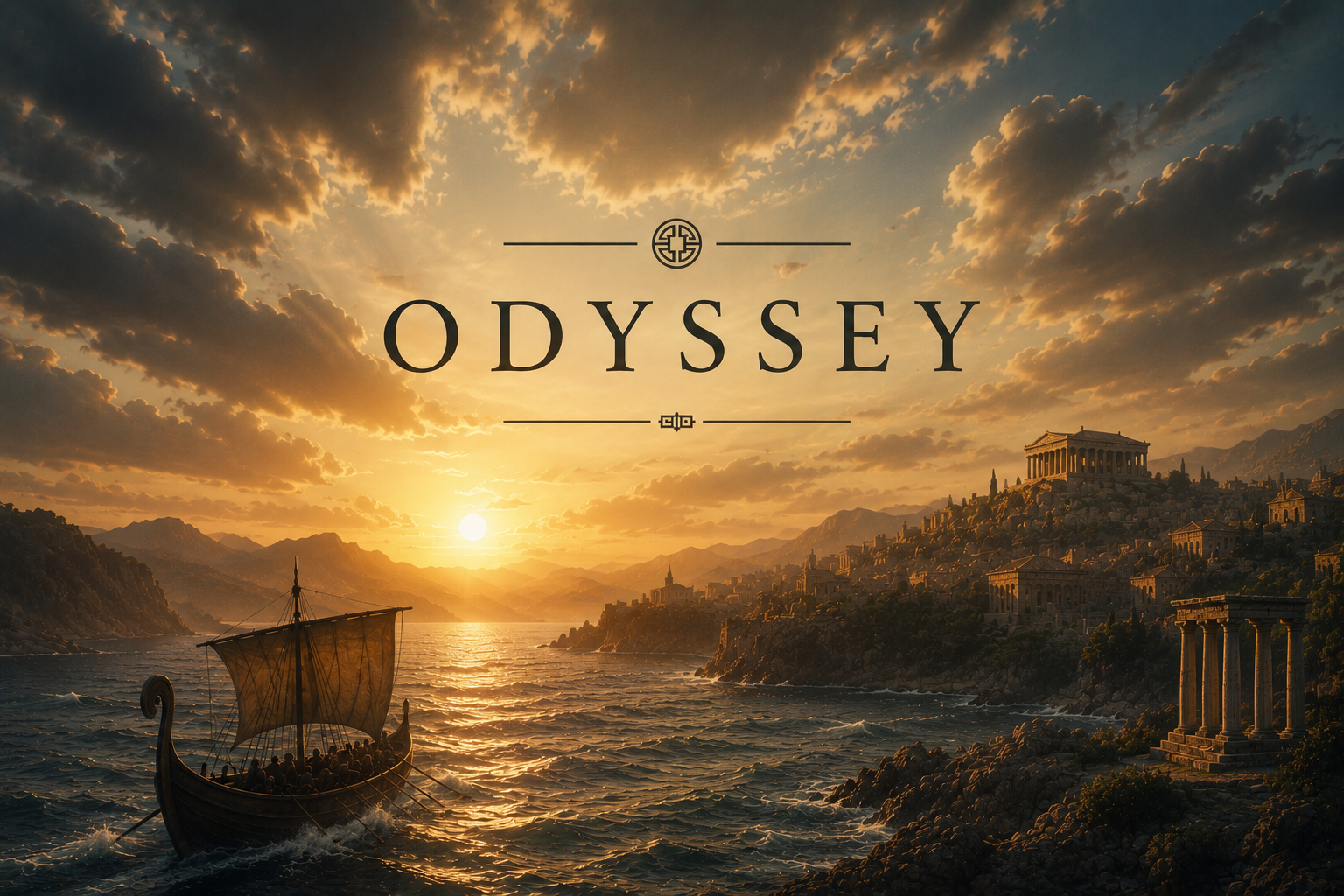
Imagine a film crew retracing a hero’s ten-year journey home — except this time, the journey takes eight months, not ten years, and the “monsters” are replaced by IMAX cameras. That’s roughly what happened when Christopher Nolan set out to bring Homer’s Odyssey to the big screen. The result is one of the most anticipated films of the year, and if you’re planning to see it, there’s a lot worth knowing before the lights go down — none of which will ruin a single plot twist.
A Director Who Doesn’t Do Things Halfway
This is Nolan’s thirteenth feature film, and by now audiences know what to expect from him: enormous scale, real locations instead of green screens, and a refusal to rely on computer-generated effects unless absolutely necessary. For Odyssey, that philosophy sent the cast and crew across six countries — Morocco, Greece, Italy, Scotland, Iceland, and Western Sahara — shooting in landscapes that actually resemble the ancient Mediterranean world rather than a studio backlot. In a sense, the production followed Odysseus’s own route, just with considerably better catering.
Who’s in It
The cast reads like a wish list. Matt Damon plays Odysseus, the Greek king trying to find his way home after the Trojan War. Around him is a striking ensemble: Tom Holland, Robert Pattinson, Anne Hathaway, Charlize Theron, Lupita Nyong’o, and Zendaya. Without giving anything away about who plays whom in the story, it’s fair to say this is one of the largest and most talent-packed casts Nolan has ever assembled.
So, What Is Homer’s Odyssey Actually About?
If your last encounter with Homer was a rushed reading in school, here’s a quick refresher — it will make the film much richer. The Odyssey is one of the oldest surviving works of Western literature, composed almost 2,800 years ago. It tells the story of Odysseus, King of Ithaca, who fought in the Trojan War and then spent ten long years trying to sail home. Along the way, he faces storms, strange creatures, and gods who either help or torment him, depending on their mood.
What makes the original poem unusual is its structure. It doesn’t move in a straight line from beginning to end. Instead, much of the adventure is told as a story-within-a-story: Odysseus himself narrates his most dangerous experiences to strangers who host him along the way. Meanwhile, back in Ithaca, his wife Penelope waits, surrounded by suitors who assume her husband is dead and want to take his place. It will be interesting to see whether Nolan — a director famous for playing with time and narrative structure in films like Memento and Dunkirk — keeps this layered storytelling or simplifies it for the screen.
Beyond the adventure, the poem carries themes that still feel relevant. There’s the idea of xenia, or hospitality — in ancient Greek culture, welcoming a stranger properly was almost a sacred duty, and several episodes in the story revolve around what happens when that duty is honored or broken. There’s also the tension between fate and free will, as Odysseus repeatedly clashes with gods who seem determined to delay him. And running through everything is the theme of identity: after twenty years away, will Odysseus even be recognized by the people he loved?
There’s also a historical layer worth knowing. The Trojan War, which the story assumes as its starting point, is traditionally placed at the end of the Bronze Age — a moment when powerful kingdoms across the eastern Mediterranean were collapsing, and much of Greece was about to enter a period historians sometimes call a “dark age,” when even writing was lost for centuries. So this isn’t just a personal survival story; it’s set at the edge of a civilization in decline, which adds a heavier undertone to Odysseus’s struggle to get home.
The Technology Behind the Spectacle
Nolan is known for pushing IMAX cameras to their limits, and this film reportedly involved newly developed camera technology, about 30% quieter than previous models and noticeably lighter — a detail that matters more than it sounds. Quieter cameras make it easier to record clean sound directly on set, and lighter equipment allows for shots that would otherwise be impossible to capture on location. If you have access to a true IMAX screen, this is very likely a film built with that format specifically in mind.
The score comes from Ludwig Göransson, the Oscar-winning composer behind Oppenheimer, so expect the music to carry as much emotional weight as the visuals.
Setting Your Expectations
Early reviews are, unsurprisingly, divided — which tends to happen with any film this ambitious. Some critics praise the film’s scale and its raw, human take on an ancient myth. Others argue that its message about war and the fragility of civilization feels a little too obvious, stated rather than discovered. Neither reaction should be surprising: adapting a 2,800-year-old story that everyone already half-knows is a genuinely difficult task, and Nolan has chosen to do it as a sweeping, myth-sized epic rather than a quiet, faithful retelling.
Go in expecting a bold, larger-than-life vision of an old story — not a history lesson, and not a word-for-word translation of Homer. Whether Odysseus makes it home is not really the question. How he gets there, and what the journey costs him, is where the film is likely to surprise you.