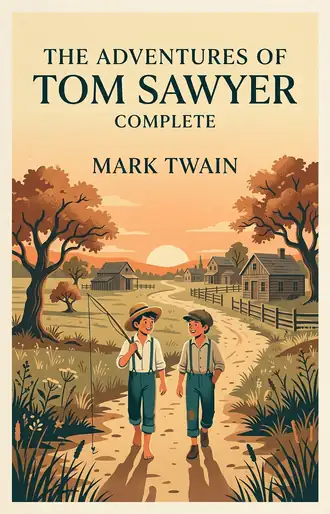
The Adventures of Tom Sawyer for English learners: level, words and how to read it
Mark Twain’s 1876 novel about a boy on the Mississippi is funny, adventurous and full of real American speech. Here is how difficult it is to read in English, which words to know and how to deal with the dialect.
- Author
- Mark Twain
- Published
- 1876
- Level
- B2
- Words
- 71,114
- Chapters
- 35
- Reading time
- ≈ 8 h

Read The Adventures of Tom Sawyer in Booklex
Free in Booklex: tap any word for its translation in context.

What the book is about
Tom Sawyer lives with his Aunt Polly in St. Petersburg, a small town on the Mississippi River. He hates school and Sunday school, loves adventure and is a master of schemes, like tricking his friends into paying him for the “privilege” of whitewashing a fence.
Then the games turn serious. One midnight in the graveyard, Tom and his friend Huckleberry Finn witness a murder and swear to keep silent. Between running away to an island to become pirates, falling in love with Becky Thatcher and searching for buried treasure, Tom has to decide whether to speak up.
Themes
- Childhood and freedom. Boys who would rather swim, fish and play pirates than sit still in church.
- Small-town America. Life on the Mississippi in the 1840s, seen with affection and a lot of humour.
- Conscience and courage. Keeping a dangerous secret, or telling the truth when it matters.
- Imagination. Tom turns everything, from chores to treasure hunts, into a story with himself as the hero.
How hard is The Adventures of Tom Sawyer to read in English?
How many unknown words will you meet? With a vocabulary of about 2,000 words, roughly 17 in every hundred, since those words cover 83.4% of the text. With 5,000 words it is about 10 in a hundred, with 10,000 about 6. Character names are not counted.
Measured by vocabulary alone, the book is B2–C1: that is the level at which almost every word is already familiar (why 98% matters). Tap-to-translate covers the rest, so you can start at B2. On our list it sits between The Time Machine, which is a little easier, and Jane Eyre, which is a little harder.
What is hard: the dialogue is written in Missouri dialect (tain’t, becuz, s’pose, dern), which frequency lists do not recognise and which you should not learn as standard English, plus American slang of the time (shucks, spunk). Please note that the book reflects the racist language and attitudes of its time. What helps: the narration itself is plain and clear, chapters are short and many episodes are genuinely funny.
Our take: B2–C1, mostly because of the dialect; the narration is easier than the numbers suggest. Great if you want to hear how real American English sounded.
Words to know before you start
The book’s own vocabulary: frequent in this text, much less common elsewhere. Ten minutes with this list makes the opening chapters smoother.
| Word | Meaning | Times in the book |
|---|---|---|
| presently | soon, after a short time (old use) | 82 |
| reckon | think, suppose (informal) | 73 |
| whispered | said very quietly | 27 |
| skiff | a small light boat | 11 |
| trifle | a little; something unimportant | 11 |
| shucks | an exclamation of mild annoyance (US, informal) | 9 |
| whitewash | a white paint for walls and fences | 8 |
| spunk | courage, spirit (informal) | 8 |
| feebly | weakly | 5 |
| warily | carefully, watching for danger | 5 |
How to read it in the original
- Read the dialect aloud. Spellings like becuz make sense when you hear them; it is simply written-down speech.
- Do not copy the dialect. Save words like reckon and shucks as informal American, and ignore spellings like tain’t.
- Start with the fence. Chapter 2, the whitewashing scene, is short, famous and a perfect taste of the book.
- Read two chapters a day. At about 2,000 words each, you will finish in under three weeks.
The first line
“Tom!” No answer. “TOM!” No answer.
Mark Twain, The Adventures of Tom SawyerNo answernobody repliedphrase in context
Tap a highlighted word
The shortest opening on our list: Aunt Polly calling for Tom, who is of course hiding. In two lines you already have the tone of the whole book.
Frequently asked questions
Is The Adventures of Tom Sawyer hard to read in English?
The narration is fairly easy, but the dialogue is full of 19th-century Missouri dialect and slang, which makes it harder than it looks. With tap-to-translate it is comfortable from B2.
What English level do I need for The Adventures of Tom Sawyer?
B2 with tap-to-translate. By vocabulary alone the book is B2–C1. If it feels too hard, start with The Time Machine, which is a little easier.
