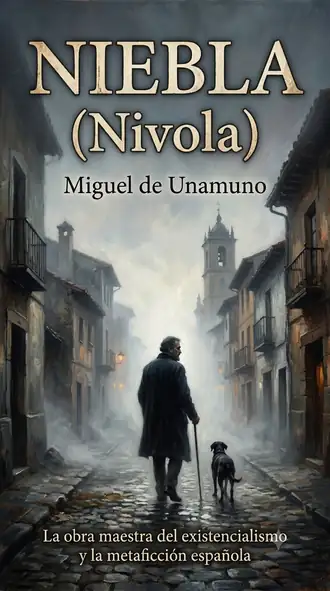
Niebla for Spanish learners: level, words and how to read it
Unamuno’s 1914 novel starts as a light love story and ends with the hero arguing with his own author. It is short, full of dialogue and written in modern Spanish, which makes it one of the easiest classics on our list. Here is how hard it is and how to read it.
- Author
- Miguel de Unamuno
- Published
- 1914
- Level
- B1–B2
- Words
- 53,947
- Chapters
- 33
- Reading time
- ≈ 6 h

Read Niebla in Booklex
Free in Booklex: tap any word for its translation in context.

What the book is about
Augusto Pérez is a rich, lonely young man with nothing to do. One rainy day he follows a pretty piano teacher, Eugenia, falls in love on the spot and decides to win her. Eugenia has a lazy boyfriend and little interest in Augusto, but she is happy to let him pay off the mortgage on her house.
Augusto talks about life, love and existence with his friend Víctor and with his dog Orfeo, and slowly starts to doubt whether he really exists. When everything goes wrong, he travels to Salamanca to visit the author of the novel, Miguel de Unamuno himself, and the conversation that follows is one of the most famous scenes in Spanish literature.
Themes
- Existence. Does Augusto exist, or is he only a character? And are we any different?
- Love as an experiment. Augusto treats falling in love as a kind of philosophical test.
- The “nivola”. Unamuno invented a new word for a novel without long descriptions, made mostly of conversation.
- Freedom. Can a character, or a person, decide his own fate?
How hard is Niebla to read in Spanish?
How many unknown words will you meet? With a vocabulary of about 2,000 words, roughly 13 in every hundred, since those words cover 87.5% of the text. With 5,000 words it is about 8 in a hundred, with 10,000 about 5. Character names are not counted.
Measured by vocabulary alone, the book is B2: that is the level at which almost every word is already familiar (why 98% matters). Tap-to-translate covers the rest, so you can start at B1–B2. It is slightly harder than Heart (Cuore) and slightly easier than A Wonder-Book for Girls and Boys.
What is hard: philosophical monologues, wordplay, a few old pronoun forms attached to verbs (quedóse, díjole) and Unamuno’s love of paradox. What helps: modern Spanish of the 20th century, very short sentences (about 12 words on average), lots of dialogue and short chapters, so the story moves fast.
Our take: B1–B2 with tap-to-translate (B2 by vocabulary). One of the best first “real” Spanish novels: easy to read, impossible to forget.
Words to know before you start
The book’s own vocabulary: frequent in this text, much less common elsewhere. Ten minutes with this list makes the opening chapters smoother.
| Word | Meaning | Times in the book |
|---|---|---|
| señorito | young gentleman; rich idle young man | 51 |
| existir | to exist | 26 |
| lágrima | tear (from the eye) | 22 |
| portera | concierge, doorkeeper (woman) | 15 |
| nivola | “nivola”: Unamuno’s made-up word for this kind of novel | 15 |
| resignarse | to resign oneself, accept | 12 |
| acariciar | to stroke, caress | 11 |
| paraguas | umbrella | 7 |
| solterón | old bachelor | 5 |
| majadero | fool, idiot | 4 |
How to read it in the original
- Enjoy the dialogues. Most of the book is conversation; read them as you would a play.
- Do not hurry through the monologues. They are short; read them twice, and the ideas become clear.
- Watch for chapter 31. That is where Augusto meets his author; it is worth the wait.
- Read two chapters a day. At about 1,600 words each, you will finish in under three weeks.
The first line
Al aparecer Augusto a la puerta de su casa extendió el brazo derecho, con la mano palma abajo y abierta, y dirigiendo los ojos al cielo quedóse un momento parado en esta actitud estatuaria y augusta.
Miguel de Unamuno, NieblaAl apareceron appearingphrase in context
Tap a highlighted word
“When Augusto appeared at the door of his house, he stretched out his right arm, palm down and open, and, raising his eyes to the sky, stood still for a moment in this statuesque and august pose.” A playful start: augusta (“august”, majestic) echoes the hero’s name, Augusto, and the grand pose is only to check whether it is raining. Note quedóse, an old way of writing se quedó.
Frequently asked questions
Is Niebla hard to read in Spanish?
Not very: modern Spanish, short sentences and lots of dialogue, B2 by vocabulary. The philosophical parts need attention, but with tap-to-translate the book works from B1–B2.
What Spanish level do I need for Niebla?
B1–B2 with tap-to-translate. By vocabulary alone the book is B2. If it feels too hard, start with Heart (Cuore), which is a little easier.
