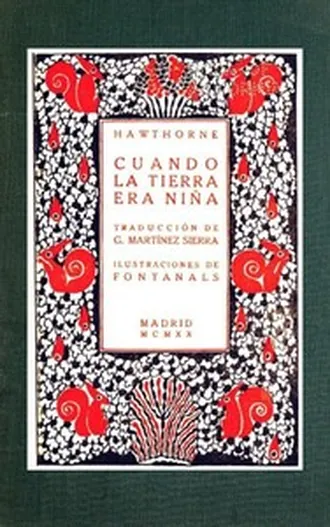
A Wonder-Book for Girls and Boys (Cuando la tierra era niña) for Spanish learners: level, words and how to read it
Greek myths retold by the author of The Scarlet Letter: Perseus, Midas, Pandora, Hercules. You already know these stories, which makes them some of the easiest texts in Spanish to follow. This is the translation by Gregorio Martínez Sierra. Here is how hard it is and how to read it.
- Author
- Nathaniel Hawthorne
- Translation
- Gregorio Martínez Sierra
- Level
- B1–B2
- Words
- 47,968
- Stories
- 6
- Reading time
- ≈ 5 h

Read Cuando la tierra era niña in Booklex
Free in the app’s library, with word translations at a tap.

What the book is about
At Tanglewood, a country house in New England, a student called Eustace Bright (Eustaquio in Spanish) tells stories to a group of children with flower names, such as Primrose (Primavera). Between his stories we see the children in the porch, by the fire and on a hill, asking questions and arguing with him.
The six myths are Perseus and the Gorgon’s head, King Midas and the golden touch, Pandora’s box, Hercules and the three golden apples, Baucis and Philemon and the miraculous pitcher, and Bellerophon taming Pegasus to fight the Chimera. Mercury appears as a cheerful traveller called Azogue (Quicksilver).
Themes
- Myths as fairy tales. Hawthorne turns Greek legends into warm, simple stories.
- Greed and its punishment. Midas learns what gold is worth when his daughter turns to metal.
- Curiosity and hope. Pandora opens the box, but Hope comes out last.
- Courage. Perseus, Hercules and Bellerophon face monsters with help and patience.
How hard is A Wonder-Book for Girls and Boys to read in Spanish?
We measured how much of the book is covered by the most frequent Spanish words (character names excluded). If you know the 2,000 most common words, you will recognise about 85.7% of the words in the book, which leaves roughly 14 unknown words in every hundred. With 5,000 words it is about 8 in a hundred, and with 10,000 words about 5.
For comfortable reading without help, researchers aim for about 98% known words (more in our guide). By vocabulary alone this is a B2 book; with tap-to-translate for the words you do not know, it is readable from B1–B2. It is slightly harder than Niebla and slightly easier than Strange Case of Dr Jekyll and Mr Hyde.
What is hard: some mythological and old-fashioned words (yelmo, brida, legua, cántaro), and the narrator’s chatty asides to the children. The frame chapters at Tanglewood describe landscapes and seasons, which is harder than the myths themselves. What helps: the spelling is modern, the vocabulary is among the most everyday of our translated books, and you already know how every story ends.
Our take: B1–B2 with tap-to-translate (B2 by vocabulary). A gentle, friendly book for building reading habits, especially if you like mythology.
Words to know before you start
These words appear often in the book but are much rarer in everyday modern Spanish. Learning them in advance makes the first chapters noticeably easier.
| Word | Meaning | Times in the book |
|---|---|---|
| forastero | stranger, outsider | 35 |
| cántaro | pitcher, jug | 29 |
| chiquillo | little kid | 27 |
| alado | winged | 21 |
| brida | bridle | 14 |
| guirnalda | garland | 13 |
| legua | league (distance, about 5 km) | 11 |
| yelmo | helmet (of a warrior) | 11 |
| sandalia | sandal | 10 |
| tazón | bowl | 10 |
How to read it in Spanish
- Start with “El toque de oro”. King Midas is short, funny and sad at the same time.
- Skip the frame chapters if you want only the myths. They are the short chapters between the myths, such as “Arroyo umbrío” or “Al amor de la lumbre”.
- Read the names twice. Azogue is Mercury and Primavera is a girl; once you know them, the rest is easy.
- One myth per evening. About 50 minutes each.
The first line
Bajo el pórtico de la quinta llamada Tanglewood, una hermosa mañana de otoño estaba reunido un alegre grupo de chiquillos, y en medio de ellos estaba en pie un joven alto.
Nathaniel Hawthorne, Cuando la tierra era niñapórticoporchnoun
Tap a highlighted word
“Beneath the porch of the country house called Tanglewood, one fine autumn morning, a merry group of children was gathered, and in the middle of them stood a tall young man.” The opening of the frame story. The Spanish keeps Hawthorne’s gentle, slow rhythm, and chiquillos, “little kids”, is one of the words you will meet most often in the book.
Frequently asked questions
Is A Wonder-Book for Girls and Boys hard to read in Spanish?
Not very. The vocabulary is close to everyday Spanish, the spelling is modern and the myths are familiar. A few old words and the descriptive frame chapters take some effort, but with tap-to-translate it works from B1–B2.
What Spanish level do I need for A Wonder-Book for Girls and Boys?
B1–B2 with tap-to-translate for unknown words; B2 if you want to read without looking anything up. If it feels too hard, start with Niebla, which is a little easier.
