Ratón Pérez for Spanish learners: level, words and how to read it
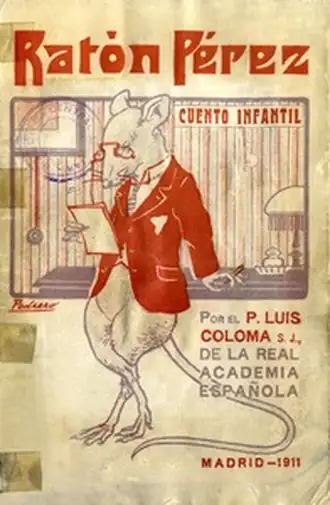
Ratón Pérez is the Spanish “tooth mouse”, the little mouse who takes children’s milk teeth from under the pillow. This short tale, written for an eight-year-old king, is where he comes from. You can read it in half an hour. Here is how difficult it is.
- Author
- Luis Coloma
- Published
- 1894
- Level
- B2
- Words
- 4,286
- Stories
- 1
- Reading time
- ≈ 1 h

Read Ratón Pérez in Booklex
Free in the app’s library, with word translations at a tap.

What the book is about
King Buby is a little boy with golden hair. When he loses a milk tooth, he puts it under his pillow with a letter, and that night Ratón Pérez arrives: a tiny mouse with a straw hat, gold glasses and a red bag. He turns the king into a mouse and takes him through the pipes of Madrid to his home, inside a box of biscuits in the cellar of a shop on Calle del Arenal.
Together they go to collect the tooth of Gilito, a very poor boy, and Buby sees for the first time how some of his subjects live. When he wakes up in his bed, he has learned what a good king should be.
Themes
- The tooth mouse. The origin of a tradition every Spanish-speaking child knows.
- A lesson for a king. Coloma wrote it for the real boy king Alfonso XIII, to teach him about his poorer subjects.
- Poverty and kindness. The visit to Gilito’s home is the heart of the story.
- Old Madrid. Real streets and shops of the city in the 1890s.
How hard is Ratón Pérez to read in Spanish?
We measured how much of the book is covered by the most frequent Spanish words (character names excluded). If you know the 2,000 most common words, you will recognise about 80.6% of the words in the book, which leaves roughly 19 unknown words in every hundred. With 5,000 words it is about 13 in a hundred, and with 10,000 words about 8.
For comfortable reading without help, researchers aim for about 98% known words (more in our guide). By vocabulary alone this is a B2–C1 book; with tap-to-translate for the words you do not know, it is readable from B2. It is slightly harder than Edgar Allan Poe: Selected Tales and slightly easier than Bécquer: Leyendas y Rimas.
What is hard: the tale is short but written in the elegant, slightly old-fashioned Spanish of the 1890s, with long sentences (about 23 words on average), many diminutives (reyecito, muñequito, ojitos) and the old spelling of the edition (á, fué). What helps: it is very short, the story is simple and familiar, and you can read it in one sitting.
Our take: B2 with tap-to-translate (B2–C1 by vocabulary). A charming half-hour read and a good way to try an older text without committing to a novel.
Words to know before you start
These words appear often in the book but are much rarer in everyday modern Spanish. Learning them in advance makes the first chapters noticeably easier.
| Word | Meaning | Times in the book |
|---|---|---|
| ratón | mouse | 37 |
| diente | tooth | 15 |
| rabo | tail | 8 |
| almohada | pillow | 7 |
| agujero | hole | 7 |
| reyecito | little king (diminutive of rey) | 7 |
How to read it in the original
- Read it in one go. At about 4,300 words, it takes around thirty minutes.
- Recognise diminutives. -ito, -ita, -cito make things small or cute; reyecito is just a little rey.
- Do not mind the old accents. Á and fué are the old spelling of a and fue.
- Retell it. The story is short enough to summarise in Spanish afterwards, which is great practice.
The first line
Era entonces el rey Buby un verdadero encanto, y cuando en los días de gala le ponían su corona de oro y su real manto bordado, no era el oro de su corona más brillante que el de sus cabellos…
Luis Coloma, Ratón Pérezverdadero encantoa real delightphrase in context
Tap a highlighted word
“King Buby was a real delight at that time, and when on feast days they put on him his gold crown and his embroidered royal cloak, the gold of his crown was no brighter than that of his hair…” King Buby is a portrait of the young Alfonso XIII, who was eight when Coloma wrote the story for him after he lost a tooth. Note the comparison no era… más brillante que, “was no brighter than”.
Frequently asked questions
Is Ratón Pérez hard to read in Spanish?
The text is short but written in elegant 19th-century Spanish, B2–C1 by vocabulary, with long sentences and old spelling. Since it takes only half an hour, with tap-to-translate it is a comfortable read from B2.
What Spanish level do I need for Ratón Pérez?
B2 with tap-to-translate for unknown words; B2–C1 if you want to read without looking anything up. If it feels too hard, start with Edgar Allan Poe: Selected Tales, which is a little easier.
