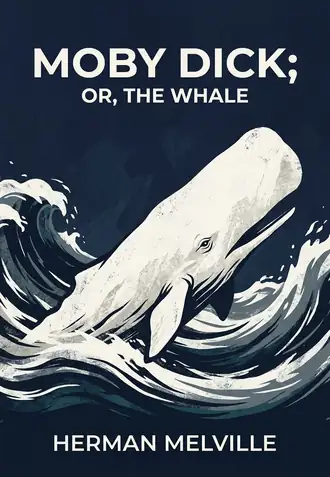
Moby-Dick for English learners: level, words and how to read it
Herman Melville’s 1851 novel is often called the greatest American book, and one of the hardest. It is long, rich and full of whaling words and philosophy. Here is how difficult it really is and how to tackle it in the original.
- Author
- Herman Melville
- Published
- 1851
- Level
- B2–C1
- Words
- 212,328
- Chapters
- 135
- Reading time
- ≈ 24 h

Read Moby-Dick in Booklex
In the app’s free library. Tap a word to see what it means.

What the book is about
Ishmael, a restless young man, decides to go to sea on a whaling ship. In New Bedford he shares a bed with Queequeg, a tattooed harpooner from the South Seas, and the two become close friends. Together they sign on to the Pequod, sailing from Nantucket.
Only at sea does the captain appear: Ahab, who lost his leg to a giant white sperm whale called Moby Dick. He has no interest in oil or money; he wants revenge, and he will drive the whole crew around the world to find the whale.
Themes
- Obsession. Ahab’s hunt shows how one fixed idea can destroy a man and everyone around him.
- Nature and its mystery. The white whale can be read as fate, God, nature or simply an animal.
- Friendship across cultures. Ishmael and Queequeg’s friendship is one of the warmest parts of the book.
- Knowledge. Melville tries to describe the whale from every side: science, history, art, the whaling trade.
How hard is Moby-Dick to read in English?
Most of this book is made of everyday English. The 2,000 most common words cover 77.6% of it, so a learner who knows only those meets about 22 new words in every hundred. At 5,000 known words that drops to around 15, and at 10,000 to about 9.
Reading without help feels easy at about 98% familiar words (see our guide), which puts this book at C1–C2 by vocabulary. You do not need to know every word in advance, though: with tap-to-translate it works from B2–C1. It is the hardest book on our list; one step easier is The Four Million.
What is hard: a huge vocabulary of whaling and sailing terms, a 19th-century style full of Bible and Shakespeare references, whole chapters on whale anatomy and classification, and very long sentences. It has the lowest word coverage on our list: the 10,000 most common words cover only about 91% of the text. What helps: Ishmael’s voice is witty and friendly, many chapters are short, and the opening chapters on land are easier than the rest.
Our take: B2–C1 with tap-to-translate (C1–C2 by vocabulary), the hardest book on our list. Not a first novel in English, but a great challenge for advanced readers with tap-to-translate.
Words to know before you start
Below are words that come up again and again in Moby-Dick but are rare in modern English. Knowing them before you start saves a lot of tapping in the first chapters.
| Word | Meaning | Times in the book |
|---|---|---|
| leviathan | a huge sea monster; a whale | 83 |
| harpoon | a spear thrown to catch whales | 76 |
| darted | moved or threw suddenly and fast | 38 |
| forecastle | the front part of a ship where sailors live | 37 |
| flukes | the two halves of a whale’s tail | 37 |
| blubber | the fat of a whale | 34 |
| gunwale | the top edge of a boat’s side | 21 |
| evinced | showed clearly (formal) | 21 |
| doubloon | an old Spanish gold coin | 20 |
| spermaceti | a waxy oil from a sperm whale’s head | 18 |
How to read it in the original
- Read the first 25 chapters as a test. If you enjoy Ishmael and Queequeg in New Bedford, keep going.
- Do not learn every whaling term. Tap, picture it and move on; only a few words (harpoon, blubber, forecastle) return constantly.
- Allow yourself to skim the whale science. Chapters like “Cetology” can be read lightly the first time.
- Plan for months, not weeks. At three short chapters a day, you will finish in about six weeks.
The first line
Call me Ishmael. Some years ago—never mind how long precisely—having little or no money in my purse, and nothing particular to interest me on shore, I thought I would sail about a little and see the watery part of the world.
Herman Melville, Moby-Dicknever mindit doesn’t matterphrase in context
Tap a highlighted word
“Call me Ishmael” is one of the most famous first lines in literature: three short words, then a long, relaxed sentence. That rhythm, short and then long, is the rhythm of the whole book.
Frequently asked questions
Is Moby-Dick hard to read in English?
Yes, it is the hardest book on our list: a huge whaling vocabulary, long philosophical passages and 19th-century style, about C1–C2 by vocabulary, B2–C1 with tap-to-translate. With tap-to-translate it is possible for advanced learners.
What English level do I need for Moby-Dick?
From B2–C1, if you translate unknown words with a tap. Reading without any help needs about C1–C2. If it feels too hard, start with The Four Million, which is a little easier.
