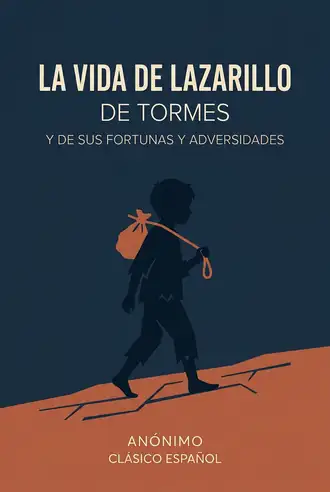
Lazarillo de Tormes for Spanish learners: level, words and how to read it
This short anonymous novel from 1554 started the picaresque genre: the life of a hungry boy told by himself. It is funny, cruel and only about two hours long, but its Spanish is almost 500 years old. Here is how difficult it is and how to read it.
- Author
- Anónimo
- Published
- 1554
- Level
- B2–C1
- Words
- 20,073
- Chapters
- 7
- Reading time
- ≈ 2 h

Read Lazarillo de Tormes in Booklex
In the app’s free library. Tap a word to see what it means.

What the book is about
Lázaro is born by the river Tormes near Salamanca. His mother hands him over to a blind beggar, and the boy learns quickly that to survive he must be cleverer than his masters. With the blind man he fights over a jug of wine, a bunch of grapes and a sausage.
Then come other masters, each in a short chapter: a stingy priest who locks the bread in a chest, a proud squire in Toledo who has nothing to eat but keeps up appearances, a friar, a seller of fake indulgences, a chaplain and a constable. In the end Lázaro, now a grown man, tells “Your Grace” how he reached his “good fortune”.
Themes
- Hunger. Almost every episode is about getting something to eat.
- Appearances. The proud, penniless squire is one of the great portraits of honour without money.
- Satire of the Church. Priests and sellers of indulgences are greedy and dishonest, which is why the book was banned for decades.
- Growing up the hard way. A boy learns that kindness is rare and cunning keeps you alive.
How hard is Lazarillo de Tormes to read in Spanish?
Most of this book is made of everyday Spanish. The 2,000 most common words cover 83.8% of it, so a learner who knows only those meets about 16 new words in every hundred. At 5,000 known words that drops to around 11, and at 10,000 to about 9.
Reading without help feels easy at about 98% familiar words (see our guide), which puts this book at C1–C2 by vocabulary. You do not need to know every word in advance, though: with tap-to-translate it works from B2–C1. On our list it sits between Don Quixote, which is a little easier, and Tradiciones peruanas, which is a little harder.
What is hard: Spanish of the 16th century, with old forms (agora for ahora, comigo for conmigo, desta for “de esta”), old verbs (tornar for “volver”), pronouns attached to verbs and long sentences joined with y. The irony of the ending is easy to miss. What helps: the book is very short, the episodes are concrete and memorable, and the first-person voice is lively and direct.
Our take: B2–C1 with tap-to-translate (C1–C2 by vocabulary). A great short first step into classic Spanish before Don Quijote.
Words to know before you start
Below are words that come up again and again in Lazarillo de Tormes but are rare in modern Spanish. Knowing them before you start saves a lot of tapping in the first chapters.
| Word | Meaning | Times in the book |
|---|---|---|
| bula | papal bull, a paid indulgence | 27 |
| alguacil | constable, town officer | 21 |
| arca | chest, trunk | 17 |
| jarro | jug | 17 |
| agora | now (old form of ahora) | 17 |
| clérigo | priest, clergyman | 14 |
| longaniza | long pork sausage | 11 |
| menester | need (ser menester: to be necessary) | 11 |
| tornar | to return; to do again (old) | 9 |
| escudero | squire, poor gentleman | 5 |
How to read it in the original
- Read one chapter (tratado) at a time. The first and third are the best known and the most fun.
- Keep a list of old forms. Agora, comigo, desta, deste, dello: a dozen forms cover most of the strangeness.
- Watch the food. Bread, wine, sausage and grapes drive the plot; the vocabulary of food is worth saving.
- Read the ending twice. Lázaro’s “good fortune” is not what it seems.
The first line
Pues sepa V.M. ante todas cosas que a mí llaman Lázaro de Tormes, hijo de Tomé González y de Antona Pérez, naturales de Tejares, aldea de Salamanca.
Anónimo, Lazarillo de Tormessepamay (you) knowverb
Tap a highlighted word
“Your Grace should know, first of all, that I am called Lázaro de Tormes, son of Tomé González and Antona Pérez, natives of Tejares, a village near Salamanca.” The book is written as a letter: V.M. is Vuestra Merced, “Your Grace”, an unknown person who has asked Lázaro to explain his life. Note the old ante todas cosas (today ante todo).
Frequently asked questions
Is Lazarillo de Tormes hard to read in Spanish?
The language is hard: 16th-century Spanish, C1–C2 by vocabulary. But the book is very short, about two hours, and the episodes are simple, so with tap-to-translate it is a realistic read from B2–C1.
What Spanish level do I need for Lazarillo de Tormes?
From B2–C1, if you translate unknown words with a tap. Reading without any help needs about C1–C2. If it feels too hard, start with Don Quixote, which is a little easier.
