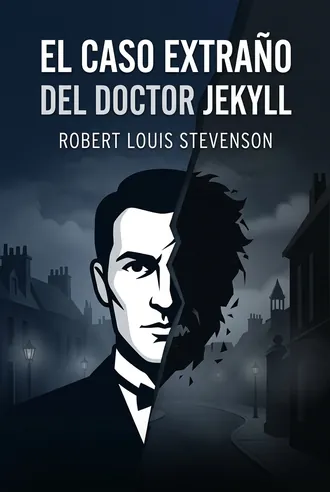
Strange Case of Dr Jekyll and Mr Hyde (El caso extraño del Doctor Jekyll) for Spanish learners: level, words and how to read it
Everyone knows the twist, and that makes this short novel a gift for learners: you can read for the atmosphere and the language instead of worrying about the plot. This is the Spanish translation by Emilio Augusto Soulère, published in New York in 1891. Here is how hard it is and how to read it.
- Author
- Robert Louis Stevenson
- Translation
- Emilio Augusto Soulère, 1891
- Level
- B2
- Words
- 26,444
- Chapters
- 10
- Reading time
- ≈ 3 h

Read El caso extraño del Doctor Jekyll in Booklex
Free in the app’s library, with word translations at a tap.

What the book is about
The lawyer Utterson hears a strange story: a small, repulsive man named Hyde trampled a child in the street and paid the family with a cheque signed by Dr Henry Jekyll, a respected scientist. Utterson is worried, because Jekyll’s will leaves everything to this Hyde. When a member of Parliament is beaten to death and the witness recognises Hyde, the mystery becomes a police case.
Jekyll locks himself in his laboratory, his old friend Doctor Lanyon dies of a shock he refuses to explain, and in the last chapters two letters reveal everything. The translator turned the names into Spanish ones: Jekyll is Enrique, and Lanyon is Lanyón.
Themes
- The double self. Good and evil live in the same person; Jekyll tries to separate them with a potion.
- Respectability and secrets. Victorian gentlemen protect each other’s reputations at any cost.
- Science and its limits. An experiment that cannot be undone.
- London at night. Fog, empty streets, street lamps and doors that should stay closed.
How hard is Strange Case of Dr Jekyll and Mr Hyde to read in Spanish?
We measured how much of the book is covered by the most frequent Spanish words (character names excluded). If you know the 2,000 most common words, you will recognise about 84.6% of the words in the book, which leaves roughly 15 unknown words in every hundred. With 5,000 words it is about 9 in a hundred, and with 10,000 words about 5.
For comfortable reading without help, researchers aim for about 98% known words (more in our guide). By vocabulary alone this is a B2–C1 book; with tap-to-translate for the words you do not know, it is readable from B2. It is slightly harder than A Wonder-Book for Girls and Boys and slightly easier than Marianela.
What is hard: the sentences are long (the longest on average of our translated books), the narrator is formal and full of nuances, and the 1891 spelling uses á for the preposition a and fué. The last two chapters are letters full of reasoning and feeling. What helps: the book is very short, under three hours of reading, the everyday vocabulary is easy, and the mystery is clear from the first chapter.
Our take: B2 with tap-to-translate (B2–C1 by vocabulary). A short, serious classic you can finish in a weekend.
Words to know before you start
These words appear often in the book but are much rarer in everyday modern Spanish. Learning them in advance makes the first chapters noticeably easier.
| Word | Meaning | Times in the book |
|---|---|---|
| pócima | potion, draught | 12 |
| pálido | pale | 12 |
| gaveta | drawer (of a desk) | 11 |
| estatura | height, stature | 10 |
| callejuela | alley, back street | 10 |
| neblina | mist, fog | 9 |
| bastón | walking stick, cane | 8 |
| farol | street lamp, lantern | 7 |
| deformidad | deformity | 5 |
| remordimiento | remorse | 4 |
How to read it in Spanish
- Read it in two or three evenings. Ten short chapters, about 20 minutes each.
- Slow down for the letters. Lanyon’s and Jekyll’s statements are the key to the book; read them twice if needed.
- Break long sentences at the semicolons. The translator builds sentences from short parts joined with ;.
- Notice the fog. Weather and light change with the mood of every scene.
The first line
El Sr. Utterson, el abogado, era un hombre de rostro duro en el cual no brillaba jamás una sonrisa; frío, lacónico y confuso en su modo de hablar…
Robert Louis Stevenson, El caso extraño del Doctor Jekyllabogadolawyernoun
Tap a highlighted word
“Mr Utterson the lawyer was a man of a rugged face that was never lighted by a smile; cold, scanty and embarrassed in discourse…” The opening portrait of the narrator’s friend Utterson. Soulère follows Stevenson closely: a list of adjectives separated by semicolons, which is a good model of how this translation builds its long sentences.
Frequently asked questions
Is Strange Case of Dr Jekyll and Mr Hyde hard to read in Spanish?
The vocabulary is around B2–C1 and the sentences are long and formal. But the book is very short and the story is famous, so with tap-to-translate it works from B2.
What Spanish level do I need for Strange Case of Dr Jekyll and Mr Hyde?
B2 with tap-to-translate for unknown words; B2–C1 if you want to read without looking anything up. If it feels too hard, start with A Wonder-Book for Girls and Boys, which is a little easier.
