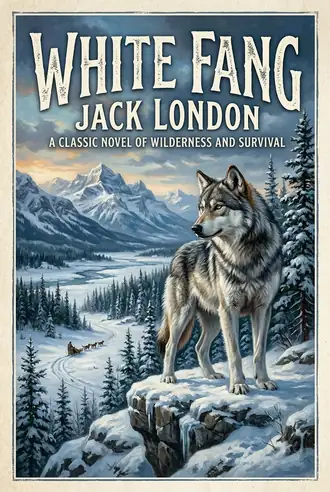
White Fang for English learners: level, words and how to read it
Jack London’s 1906 novel follows a wolf-dog from the frozen Yukon to sunny California. It is exciting and often brutal, and its descriptive style uses a lot of rare words. Here is how difficult it is and how to read it in the original.
- Author
- Jack London
- Published
- 1906
- Level
- B2–C1
- Words
- 72,919
- Chapters
- 25
- Reading time
- ≈ 8 h

Read White Fang in Booklex
Free in the app’s library, with word translations at a tap.

What the book is about
The book opens with two men and their sled dogs crossing the frozen wilderness of northern Canada, hunted night after night by a starving wolf pack. Then the story turns to the pack itself, and to a grey cub, three-quarters wolf and one-quarter dog, born in a cave.
The cub is taken in by Grey Beaver, a Native American who names him White Fang. He learns the harsh law of the wild, is sold to a cruel man who forces him to fight other dogs for money, and is finally rescued by Weedon Scott, who tries to teach him to trust humans.
Themes
- Nature and nurture. White Fang is shaped by how he is treated: cruelty makes him savage, kindness changes him.
- Survival. “Eat or be eaten” is the first law White Fang learns.
- Love and trust. The slow change from fear to loyalty is the heart of the story.
- A mirror of The Call of the Wild. That book follows a dog going wild; this one, a wild animal becoming tame.
How hard is White Fang to read in English?
We measured how much of the book is covered by the most frequent English words (character names excluded). If you know the 2,000 most common words, you will recognise about 80.9% of the words in the book, which leaves roughly 19 unknown words in every hundred. With 5,000 words it is about 11 in a hundred, and with 10,000 words about 7.
For comfortable reading without help, researchers aim for about 98% known words (more in our guide). By vocabulary alone this is a C1–C2 book; with tap-to-translate for the words you do not know, it is readable from B2–C1. It is slightly harder than Frankenstein and slightly easier than The Four Million.
What is hard: long passages of description and animal psychology with many rare words (bristling, slunk, cowered, spasmodically), northern words (musher, ptarmigan, tepee) and little dialogue. It has one of the lowest coverages on our list: the 10,000 most common words cover about 93% of the text. What helps: a clear, exciting story, a limited set of situations (hunting, fighting, travelling) that repeat their vocabulary, and short chapters.
Our take: C1–C2 by vocabulary. The words repeat a lot, so it gets easier as you go. Great for animal and adventure lovers with a solid B2+.
Words to know before you start
These words appear often in the book but are much rarer in everyday modern English. Learning them in advance makes the first chapters noticeably easier.
| Word | Meaning | Times in the book |
|---|---|---|
| sled | a vehicle that slides over snow | 62 |
| snarl | an angry sound with teeth showing; to make it | 46 |
| fangs | long sharp teeth | 40 |
| sprang | jumped suddenly (past of “spring”) | 40 |
| musher | a driver of a dog sled | 29 |
| bristling | with hair standing up in anger or fear | 27 |
| leaped | jumped | 27 |
| ptarmigan | a northern bird that turns white in winter | 24 |
| growled | made a low angry sound | 22 |
| crouched | bent low, ready to jump or hide | 19 |
How to read it in the original
- Learn the “animal action” words early. Snarl, growl, bristle, crouch, leap appear on almost every page.
- Do not panic in part one. The opening chase is the most descriptive; the story becomes more direct once White Fang is born.
- Read it with The Call of the Wild in mind. If you have read it, you will recognise much of the vocabulary.
- Read a chapter a day. About 3,000 words: the whole book in under four weeks.
The first line
Dark spruce forest frowned on either side the frozen waterway.
Jack London, White Fangsprucea kind of fir treenoun
Tap a highlighted word
A short, powerful opening: the forest “frowned”, as if it were angry. Note the old structure on either side the frozen waterway, without “of”.
Frequently asked questions
Is White Fang hard to read in English?
Yes, the vocabulary is demanding, about C1–C2 by vocabulary, B2–C1 with tap-to-translate: lots of description, animal behaviour and northern words, with little dialogue. But the words repeat, and the story is gripping.
What English level do I need for White Fang?
B2–C1 with tap-to-translate for unknown words; C1–C2 if you want to read without looking anything up. If it feels too hard, start with Frankenstein, which is a little easier.
