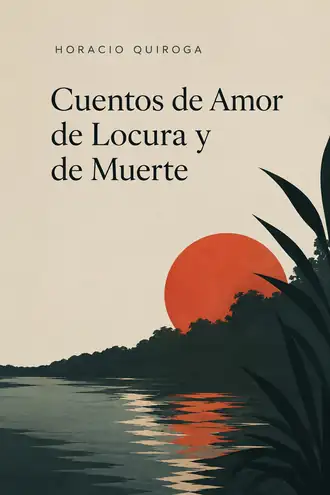
Cuentos de amor de locura y de muerte for Spanish learners: level, words and how to read it
Horacio Quiroga’s 1917 collection is the classic of the Latin American short story: eighteen tales of love, madness and death, many set in the jungle of Misiones. They are short and gripping, but dark. Here is how difficult they are to read in Spanish.
- Author
- Horacio Quiroga
- Published
- 1917
- Level
- B2
- Words
- 49,840
- Stories
- 18
- Reading time
- ≈ 6 h

Read Cuentos de amor de locura y de muerte in Booklex
Free in Booklex: tap any word for its translation in context.

What the book is about
Quiroga, an Uruguayan writer who lived for years in the subtropical forest of northern Argentina, is often called the Latin American Poe. In “El almohadón de pluma” a young wife grows weaker every day and no doctor can say why, until someone looks inside her feather pillow. In “A la deriva” a man bitten by a snake drifts down the river in his canoe, hoping to reach help.
Other stories follow animals that sense death, workers exploited in the logging camps, and children in danger. The most disturbing, “La gallina degollada”, is one of the most famous and cruel stories in the language.
Themes
- Nature as a force. The jungle, the river and the sun are as powerful as any character.
- Death. It comes suddenly, often from something small: a snake, an insect, the heat.
- Madness and obsession. Love and fear push characters past the edge.
- Exploitation. The stories of the mensú show the brutal life of the logging workers.
How hard is Cuentos de amor de locura y de muerte to read in Spanish?
How many unknown words will you meet? With a vocabulary of about 2,000 words, roughly 19 in every hundred, since those words cover 81.4% of the text. With 5,000 words it is about 12 in a hundred, with 10,000 about 8. Character names are not counted.
Measured by vocabulary alone, the book is C1: that is the level at which almost every word is already familiar (why 98% matters). Tap-to-translate covers the rest, so you can start at B2. It is slightly harder than Around the World in Eighty Days and slightly easier than A Christmas Carol.
What is hard: regional words from Argentina and Paraguay (chacra, peón, obraje, pajonal, mensú), precise descriptions of plants and animals, and some very dark content, including violence against children in “La gallina degollada”. What helps: short stories of 1,500 to 4,000 words, a clear, economical style and strong plots that make you want to know what happens.
Our take: B2 with tap-to-translate (C1 by vocabulary). Short, powerful stories; start with “A la deriva” and “El almohadón de pluma”.
Words to know before you start
The book’s own vocabulary: frequent in this text, much less common elsewhere. Ten minutes with this list makes the opening chapters smoother.
| Word | Meaning | Times in the book |
|---|---|---|
| peón | farmhand, labourer | 37 |
| rabioso | rabid; furious | 25 |
| alambrado | wire fence | 22 |
| obraje | logging camp (in Misiones) | 18 |
| chacra | small farm (South America) | 17 |
| sollozo | sob | 15 |
| aullido | howl | 14 |
| lívido | pale, ghastly | 9 |
| pajonal | tall-grass field | 8 |
| almohadón | large pillow, cushion | 7 |
How to read it in the original
- Start with the shortest. “A la deriva” and “El almohadón de pluma” are only a few pages each.
- Save regional words separately. Chacra, peón, mensú are typical of the River Plate region; label them so you know where they are used.
- Read each story in one sitting. Quiroga builds tension towards the last lines.
- Skip a story if it is too dark. Each one stands alone.
The first line
Era el martes de carnaval. Nébel acababa de entrar en el corso, ya al oscurecer, y mientras deshacía un paquete de serpentinas, miró al carruaje de delante.
Horacio Quiroga, Cuentos de amor de locura y de muerteacababa de entrarhad just enteredphrase in context
Tap a highlighted word
“It was Carnival Tuesday. Nébel had just joined the parade, as darkness fell, and as he unwrapped a packet of paper streamers, he looked at the carriage in front.” The book opens with “Una estación de amor”, a love story at a carnival parade, far from the jungle of later stories. Note el corso, the carnival procession of carriages, a word you will rarely meet outside the River Plate region.
Frequently asked questions
Is Cuentos de amor de locura y de muerte hard to read in Spanish?
The vocabulary is around C1 because of regional and nature words, and some stories are very dark. But each story is short and the style is clear, so with tap-to-translate they work from B2.
What Spanish level do I need for Cuentos de amor de locura y de muerte?
B2 with tap-to-translate. By vocabulary alone the book is C1. If it feels too hard, start with Around the World in Eighty Days, which is a little easier.
