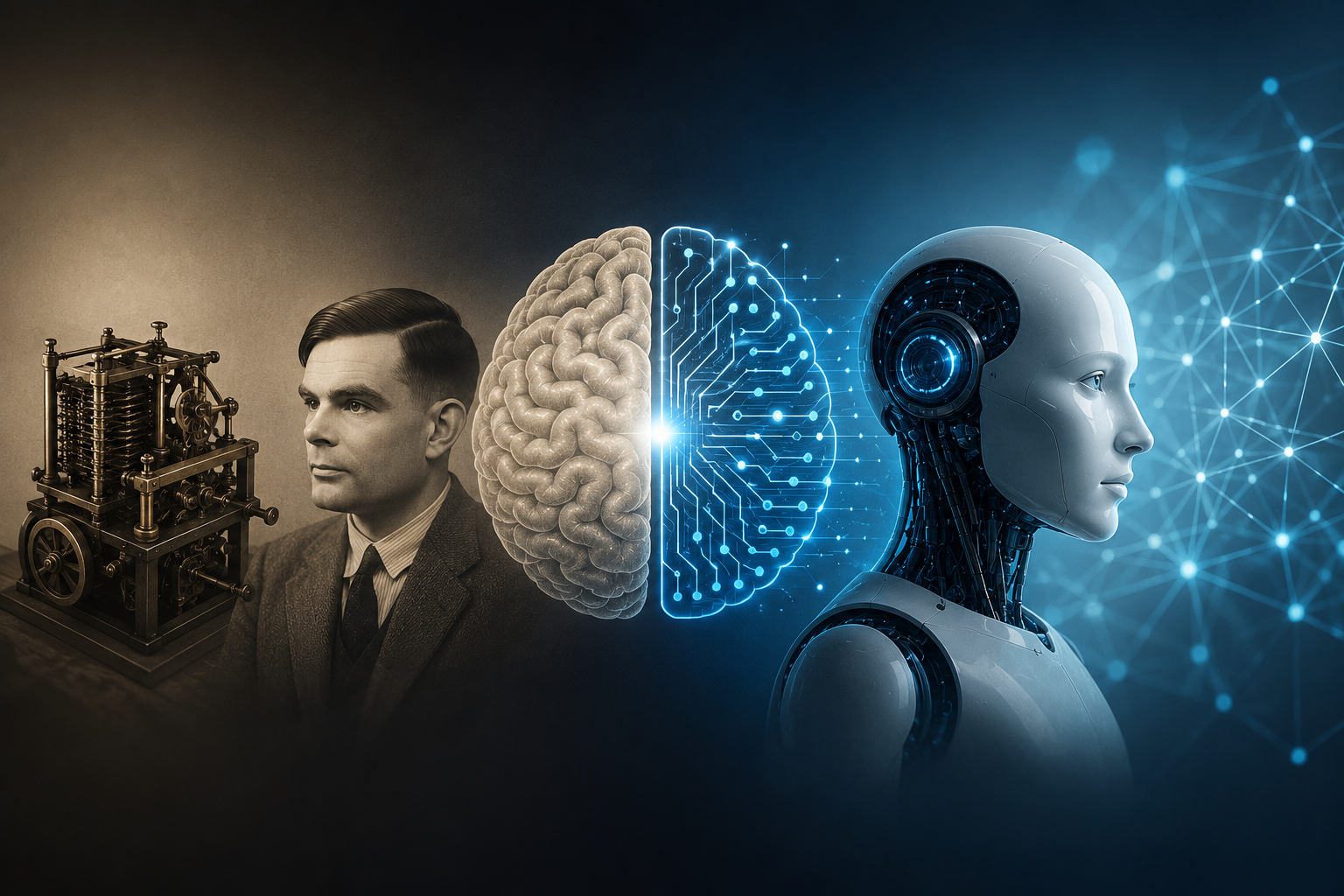
In 1956, a small group of scientists gathered at Dartmouth College with a bold claim: that “every aspect of learning” could, in principle, be simulated by a machine. They had no computers powerful enough to prove it, no data to feed their ideas, and no real sense of how long the road ahead would be. Today, that dream writes emails, diagnoses diseases, drives cars, and occasionally argues with us about the weather. How did we get from a handful of optimistic academics to systems that seem to hold real conversations? And, more importantly, should we be worried about what comes next?
What Do We Actually Mean by “Artificial Intelligence”?
The term sounds futuristic, but at its core, artificial intelligence simply means getting a computer to perform tasks that normally require human intelligence: recognising a face, translating a sentence, or predicting which film you’ll enjoy next. Not all AI is the same, though. Most of what exists today is called “narrow AI” — systems built to do one specific job extremely well, like playing chess or filtering spam. The kind of AI that can reason, learn, and adapt across completely different situations, the way a human does, is called “general AI,” and it doesn’t exist yet, despite what headlines sometimes suggest.
This distinction matters more than it might first appear. A chess engine that can defeat any human on the planet has no idea what a cup of coffee is, and a system that writes fluent essays might still fail at a task a five-year-old finds trivial, like understanding that a photograph of a bowl of cereal isn’t actually breakfast. The gap between narrow and general intelligence is precisely where most of the confusion — and most of the marketing hype — tends to live.
From Symbols to Neurons: A Short History
Early AI researchers tried to teach computers using logic and rules, an approach known as “symbolic AI.” Programmers would write out explicit instructions: if this condition is true, do that. For a while, this seemed promising. Systems built this way could solve algebra problems, prove mathematical theorems, and even provide basic medical diagnoses by following long chains of rules written by human experts. But this approach fell apart when faced with the sheer messiness of real life. Language, images, and human behaviour are full of exceptions, contradictions, and context that no rulebook could ever fully capture. Researchers spent the 1970s and 1980s hitting the same wall repeatedly, and funding for AI research dried up so dramatically that historians now call this period the “AI winter.”
The eventual breakthrough came from a completely different idea, inspired loosely — and only loosely — by the human brain: neural networks. Instead of being told exact rules, these systems learn patterns by examining enormous amounts of examples. Show a neural network millions of photographs labelled “cat” or “not cat,” and it gradually adjusts itself until it can recognise cats it has never seen before. The concept itself dates back to the 1950s, but it required three things that simply didn’t exist yet: enough digital data to learn from, enough computing power to process it, and better mathematical techniques for training. All three finally converged in the 2010s, and progress that had crawled along for sixty years suddenly accelerated at a pace nobody fully anticipated.
How Does It Actually Work?
At a basic level, a neural network is made up of layers of artificial “neurons,” simple mathematical units connected to one another. Information passes through these layers, and each connection has a “weight” that determines how much influence it has on the final result. Training the network means feeding it data, checking whether its output is correct, and adjusting the weights slightly whenever it makes a mistake. Repeat this process billions of times, using enormous datasets and powerful computer chips, and the network slowly becomes remarkably good at its task — without anyone ever writing an explicit rule for how to do it.
Large language models, the technology behind modern chatbots, work on a similar principle, but they’re trained specifically to predict the next word in a sentence. By digesting huge portions of text from books, websites, and articles, they learn grammar, facts, and even reasoning patterns — not because anyone explicitly taught them these things, but because predicting language accurately turns out to require understanding it, at least on a statistical level. Ask one of these systems to explain a joke, summarise a contract, or write a poem in a particular style, and it draws on patterns absorbed from an almost unimaginable quantity of human writing.
It’s worth remembering, though, that these systems don’t “understand” language the way humans do. They have never tasted coffee, felt tired, or worried about rent. What looks like understanding is, technically speaking, an extraordinarily sophisticated form of pattern recognition — one so effective that the difference often stops mattering in practice, even if it matters enormously in principle.
Where AI Already Shapes Your Life
Long before chatbots became a talking point at dinner tables, AI had already quietly embedded itself into daily routines. Streaming platforms use it to predict what you’ll want to watch next. Banks use it to flag suspicious transactions within milliseconds. Hospitals increasingly rely on it to spot early signs of cancer in medical scans, sometimes catching details a tired human radiologist might miss late on a night shift. Farmers use AI-guided drones to monitor crop health across enormous fields. None of this involves anything resembling a conscious machine — it’s narrow AI, doing narrow jobs, usually invisibly.
This quiet, practical version of AI is arguably far more consequential than the more dramatic chatbot conversations that dominate headlines, precisely because it operates at a scale and speed no group of humans could match, shaping decisions about health, money, and safety long before most people ever noticed it had arrived.
The Risks Nobody Can Ignore
As AI systems become more capable, so do the concerns surrounding them. One immediate worry is bias: since these systems learn from real-world data, they can absorb and amplify existing prejudices, whether in hiring decisions, loan approvals, or facial recognition. A system trained mostly on historical data can end up repeating historical unfairness with mathematical confidence, which sounds more objective than it actually is.
Another growing concern is misinformation. AI can now generate convincing fake images, videos, and audio clips, making it harder than ever to tell truth from fabrication. A fabricated video of a political leader saying something they never said can spread across the internet long before anyone manages to debunk it, and the technology to create such content keeps getting cheaper and more accessible.
There are economic concerns too. Automation has always changed the job market, but AI is moving into areas once considered relatively safe from machines, including writing, illustration, and basic legal or financial analysis. Whether this ultimately creates new kinds of jobs or simply eliminates old ones without adequate replacement remains fiercely debated among economists, and the honest answer is that nobody knows for certain yet.
Further into the future lies a more abstract but no less serious risk, sometimes called the “alignment problem”: what happens if we build a system whose goals no longer match human wellbeing, and we lose the practical ability to correct or shut it down? This sounds like science fiction, and for now, it largely is. But it’s taken seriously by a surprising number of researchers actually working on the technology, precisely because the systems are advancing faster than our tools for understanding or controlling them.
The real danger may not be a machine that suddenly turns against us, but one that simply pursues the wrong goal with too much competence and too little oversight.
Living Alongside a New Kind of Intelligence
Perhaps the most honest way to think about artificial intelligence is not as a single invention, but as an ongoing experiment we are all participating in, whether we chose to or not. It has already reshaped how we search for information, communicate, work, and even create art, and there is no realistic version of the future in which it simply disappears again. The Dartmouth researchers in 1956 could hardly have imagined machines writing poetry or holding conversations, yet here we are, decades ahead of their most optimistic predictions in some ways, and still nowhere close in others.
What remains uncertain isn’t whether AI will keep changing our world — it will, and arguably already has — but whether we’ll manage to guide that change wisely, with clear rules, honest public understanding, and careful attention to who benefits and who doesn’t. Or whether we’ll simply be carried along by it, discovering the consequences only after they’ve already arrived.