Do you want to learn a new language? Reading books can help you a lot. Many people think reading is only for advanced learners. This is not true. Even beginners can use books to learn new words and understand grammar better. In this article, you will learn how to use books to improve your language skills. The tips are simple and easy to follow.
Why reading is one of the best ways to learn a language
Reading is a great way to learn a language for many reasons. First, you see real sentences. You see how words work together. This helps you understand grammar in a natural way. You don’t need to study long grammar rules. You just see the language in action.
Second, reading gives you new words. Every book has hundreds of words. Some words you already know. Some words are new. Your brain learns these new words little by little. This is called natural learning.
Third, reading is fun. You can choose a story you like. You can read about sports, animals, love, or adventure. When learning is fun, it is easier to continue. Many people stop learning a language because it feels boring. Reading a good story can fix this problem.
When should you start reading in a foreign language?
Some people think you need to be an expert before you start reading. This is wrong. You can start reading as soon as you know some basic words. Even 200 or 300 words are enough to begin.
Of course, at the beginning, you will not understand everything. That is okay. You don’t need to understand every word. You need to understand the general idea. This is a normal part of learning.
The best time to start is now. Don’t wait until you feel “ready.” You become ready by reading, not before it.
How to choose a book at your level
Choosing the right book is very important. If the book is too hard, you will feel tired and stop reading. If the book is too easy, you will not learn new words.
Here are some simple tips for choosing a good book:
- Look at one page. If you don’t know more than 5-10 words on that page, the book is a good level for you.
- Choose a topic you already like. If you love animals, choose a book about animals.
- Start with short books or short stories. Long books can feel too difficult at first.
- Graded readers are great for beginners. These are books written for language learners, with simple words and short sentences.
Remember: the goal is to enjoy the story, not to feel stressed.
Should you translate every unknown word?
Many learners ask this question: “Should I look up every new word?” The answer is no. If you stop after every word, reading becomes slow and boring. You will lose the story.
Instead, try this simple rule: if you don’t understand a word, keep reading. Try to guess the meaning from the sentence. Often, the next sentences will help you understand.
Only look up a word if:
- You see it many times in the book, or
- You cannot understand the sentence at all without it.
This way, you read faster and enjoy the story more. You also train your brain to guess meaning, which is a very useful skill.
How many new words should you learn from one chapter?
You don’t need to learn every new word from a chapter. This is too much for your brain. A good number is 5 to 10 new words per chapter.
Choose words that you see often. If a word appears two or three times, it is probably important. Words that appear only once are less important. You can skip them.
Learning fewer words, but learning them well, is better than learning many words and forgetting them fast.
How to remember vocabulary from books
Finding new words is easy. Remembering them is harder. Here are simple ways to remember new vocabulary:
- Write it down. Keep a small notebook or use an app. Write the word and a simple example sentence.
- Use flashcards. Flashcards help your brain remember words over time. Look at them for a few minutes every day.
- Use the word in a sentence. Try to make your own sentence with the new word. This helps your brain connect the word to real life.
- Review often. Look at your word list again after one day, then after one week, then after one month. This is called spaced repetition, and it works very well.
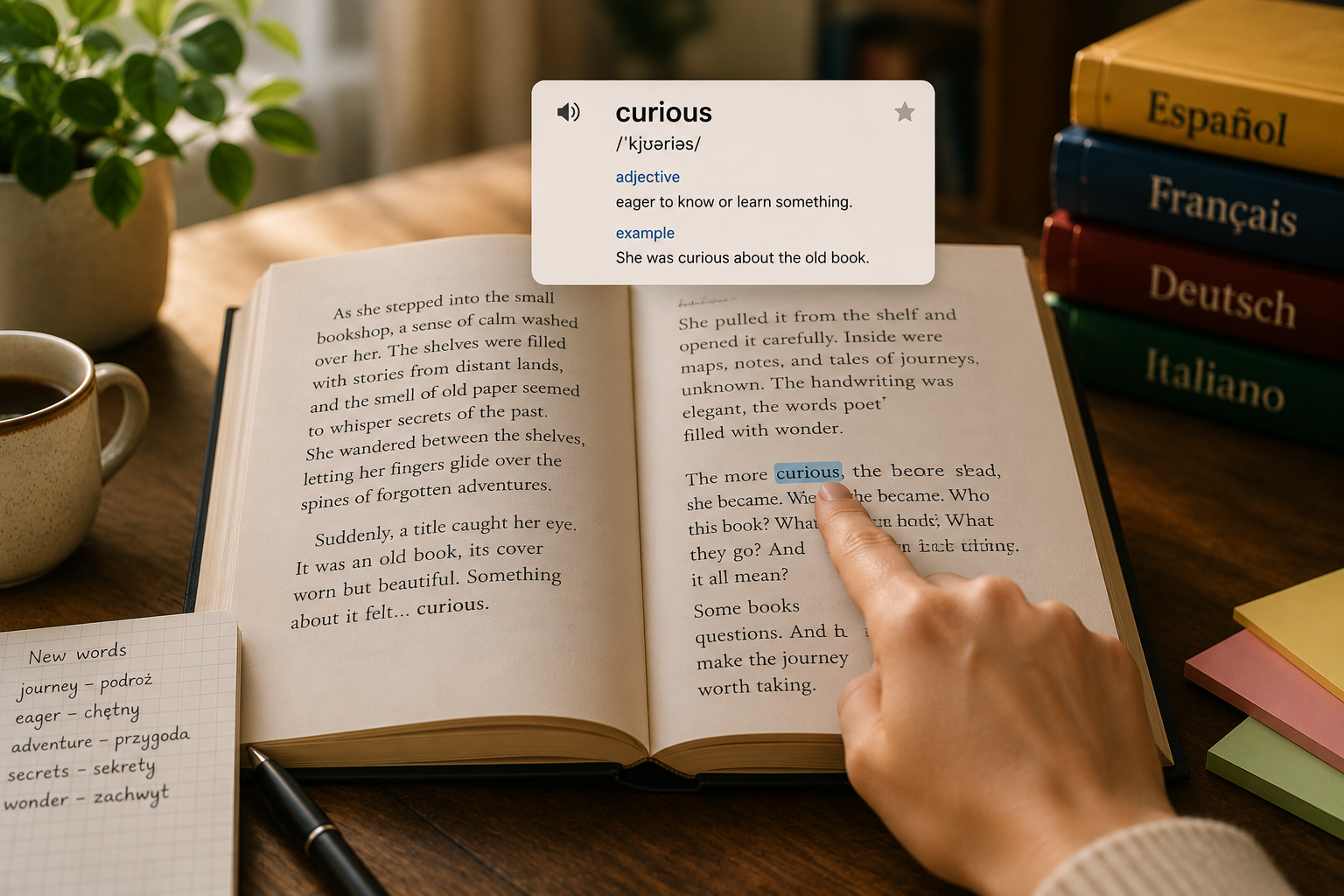
While you read here, you don’t need a separate notebook. Just tap a new word and save it to your dictionary. From there, you can practice it in different ways: flashcards, exercises, quizzes, and even a spelling bee. Trying a word in a few different ways like this helps it stay in your memory much longer.
Read aloud vs. read silently
Both reading aloud and reading silently are useful, but they help in different ways.
Reading aloud helps your pronunciation. You practice saying the words. You also hear the language, which trains your ears. Try reading aloud for 5-10 minutes a day.
Reading silently is faster. You can read more pages in less time. This is good for understanding the story and building general reading speed.
A good idea is to mix both. Read most of the book silently. Sometimes, read a page aloud, especially if you find dialogue or interesting sentences.
A simple 20-minute daily reading routine
You don’t need hours to see progress. Just 20 minutes a day can make a big difference. Here is a simple routine you can follow:
- Minutes 1-15: Read your book. Try to focus on the story. Don’t stop for every word.
- Minutes 15-18: Write down 3-5 new words you noticed. Choose words that repeat.
- Minutes 18-20: Read your word list from yesterday. This is quick review.
Do this every day, and after one month, you will notice a real change. Your vocabulary will grow, and reading will feel easier.
How to turn any book into a language-learning exercise
You can turn any book into a powerful learning tool. Here are some easy exercises:
- Summarize. After each chapter, say or write 2-3 sentences about what happened. This checks your understanding.
- Predict. Before you read a chapter, guess what will happen. This makes you think in the language.
- Find patterns. Notice grammar you already studied. For example, find all the past tense verbs on a page.
- Talk about it. Tell a friend, in the new language, what the book is about. Speaking about what you read helps you remember it better.
These small exercises turn passive reading into active learning.
How Booklex can help
Reading a book in a new language can still feel difficult, especially for beginners. This is where Booklex can help. Booklex is an app for reading books and learning languages at the same time.
With Booklex, you can open any book and simply tap on a word you don’t know. The translation appears right away, with no need to stop and search in another app. You can save new words easily and turn them into flashcards. This makes review fast and simple, just like the routine described above.
Booklex supports more than 50 languages, so you can use it no matter which language you are learning. Whether you are reading a simple story for beginners or a longer novel, Booklex helps you stay in the story, not in the dictionary.
The next time you open a book, remember: every page is a small step forward. With patience, a good book, and the right tools, reading can become one of your favorite ways to learn.