Look up on a sunny day. The sky is blue. People ten thousand years ago knew this too. But here is a strange thing: for most of history, nobody could say why. Even very clever people got the answer wrong.
In this article, we will ask some simple questions about the colours around us. Why is the sky blue? Why is it not purple? Why is the sunset red? Why are clouds white? And what colour is the sky on other worlds? The answers are easy to understand, and some of them are a real surprise.
First, a secret about sunlight
Sunlight looks white or yellow to us. But it is not one colour. It is a mix of many colours: red, orange, yellow, green, blue and violet. Violet is a dark purple colour.
The English scientist Isaac Newton showed this in the 1660s. He was in a dark room. He let a thin line of sunlight come in through a small hole. Then he put a prism in the light. A prism is a piece of glass with three sides. The white light went into the glass, and a line of colours came out on the other side. It looked like a rainbow on the wall.
You can see this secret yourself. A rainbow in the sky works in the same way. But this time, the “prisms” are millions of very small drops of rain.
Light travels like a wave in the sea. Some colours have long waves, and some colours have short waves. Red light has the longest waves. Blue and violet light have the shortest waves. Remember this. It is the key to everything in this article.
Why is the sky blue?
The air around us is not empty. It is full of very, very small things called molecules. Most of them are molecules of two gases: nitrogen and oxygen. You cannot see them.
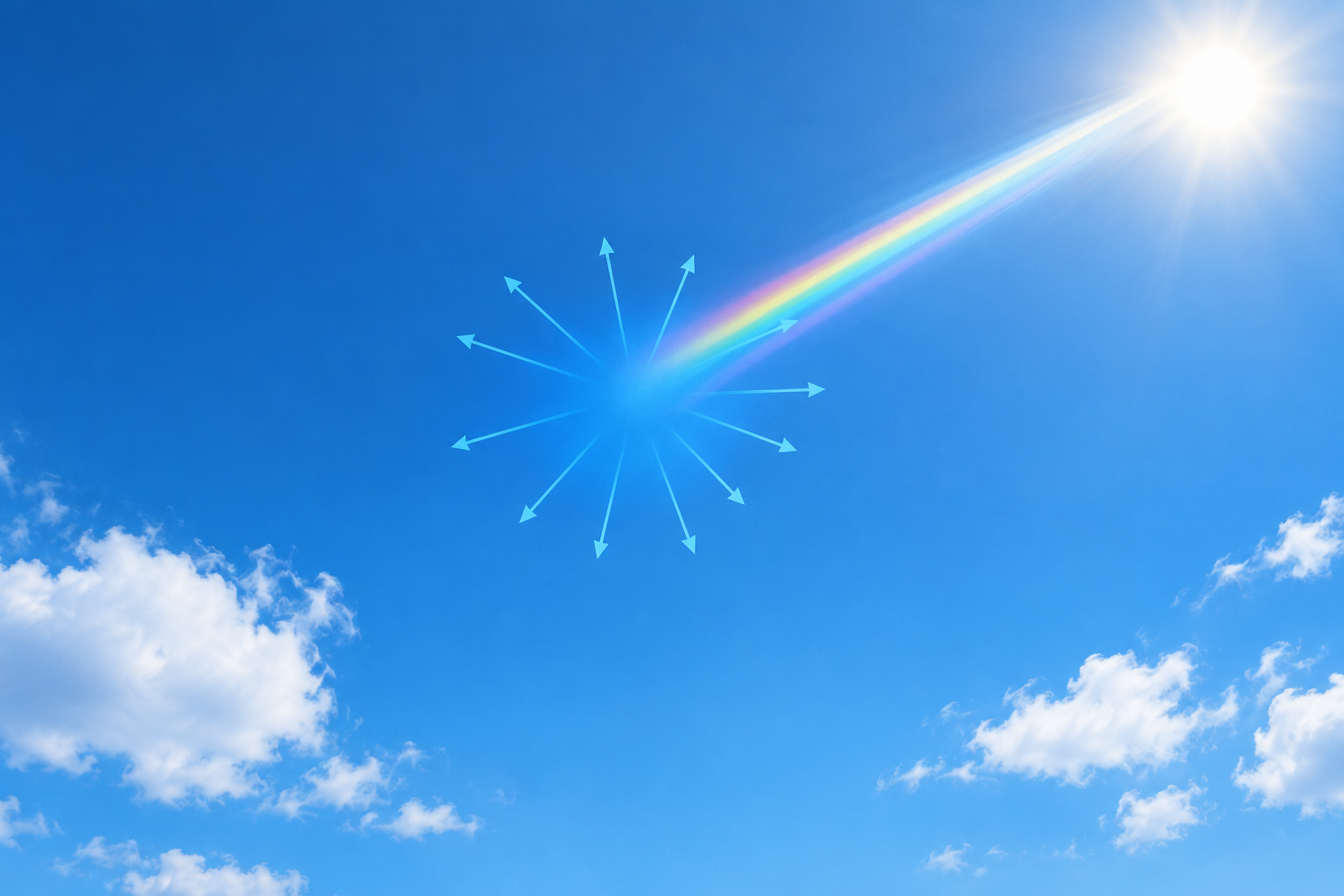
When sunlight comes to Earth, it hits these molecules. The molecules send some of the light away in all directions — up, down, left and right. Scientists call this scattering.
Here is the important part. The molecules do not scatter all colours in the same way. They scatter short waves much more than long waves. Blue light has short waves, so the air scatters a lot of blue light. Red light has long waves, so most of it goes straight through the air.
The air scatters blue light about five times more than red light.
So the blue light goes everywhere in the sky. It comes to your eyes from every direction. When you look up, you see blue light coming from all parts of the sky. That is why the whole sky looks blue.
The British scientist Lord Rayleigh explained this in 1871. Today, scientists still call it “Rayleigh scattering”.
But here is a good question. Violet light has even shorter waves than blue light. So the air scatters violet light even more than blue light. Then why is the sky not violet?
There are three reasons.
- The Sun sends us less violet light than blue light.
- Some violet light stops very high in the sky. It does not come down to us.
- Our eyes are not very good at seeing violet. They are much better at seeing blue.
So there is some violet in the sky, but our eyes mix everything together, and we see light blue. The colour of the sky is not only about the air. It is also about our eyes.
Why are sunsets red and orange?
At midday, the Sun is high above you. Its light comes down through the air in a short line. But in the evening, the Sun is low. Its light comes to you from the side. Now it must travel through much more air — many times more than at midday.
On this long trip, the air scatters most of the blue light away. It goes in other directions, and it never comes to your eyes. What is left? The long waves: red, orange and yellow. So the Sun and the sky near it look red and orange.
Dust and smoke can make sunsets even more red. In 1883, a volcano called Krakatoa in Indonesia exploded. It sent a huge cloud of dust very high into the sky. For many months after that, people all over the world saw very red and beautiful sunsets.
Why are clouds white?
Clouds are made of very small drops of water or small pieces of ice. These drops are small, but they are much bigger than air molecules.
Big things scatter light in a different way. They do not choose blue. They scatter all the colours the same amount: red, green, blue and all the others. And what do you get when you mix all the colours? White! That is why clouds are white.
But some clouds are dark grey. Why? A big rain cloud is very thick. It can be several kilometres high. Light goes into the top of the cloud, but very little light comes out of the bottom. So when you stand under the cloud, it looks grey or even black. It is the same white water — but in a shadow.
Why is the sea blue?
Many people think the sea is blue because it shows the blue sky, like a mirror. This is partly true. On a grey day, the sea often looks grey too.
But there is another reason, and it is a surprise. Water itself has a very light blue colour. Water takes in, or absorbs, a little red light. In a glass of water, you cannot see this. There is not enough water. But in the sea, light travels through many metres of water. The water absorbs more and more red light. The blue light stays. So deep, clean water looks blue, even under a grey sky.
Divers know this very well. Ten metres under the sea, red things do not look red any more. They look brown or dark. The red light cannot come down that deep.
What colour is the sky on other worlds?
Our blue sky comes from our air. So what happens in a place with no air? The answer is the Moon. The Moon has almost no air. So there is nothing to scatter the sunlight. On the Moon, the sky is black — even in the middle of the day! The astronauts of the Apollo missions walked on the Moon between 1969 and 1972. They saw a bright Sun in a black sky.
The planet Mars is even stranger. Mars has very thin air, and a lot of red dust. This dust flies high in the sky. In the day, the dust makes the sky of Mars look yellow-brown, like the colour of caramel. But at sunset, the sky near the Sun on Mars turns blue. NASA robots on Mars have taken photos of these blue sunsets. So on Mars, it is the opposite of Earth: the day sky is not blue, but the sunset is.
Small questions, big ideas
“Why is the sky blue?” sounds like a question for small children. But to answer it, we need to understand sunlight, waves, air, our eyes and even other planets. A blue sky, a red sunset, a white cloud and a blue sea all come from one simple idea: light meets something on its way, and some colours go away while others stay.
Next time you look at the sky, try to remember this. The blue above you is sunlight that has hit billions of tiny molecules. And here is one more question for you to think about: if you could choose, what colour of sky would you like to live under?