
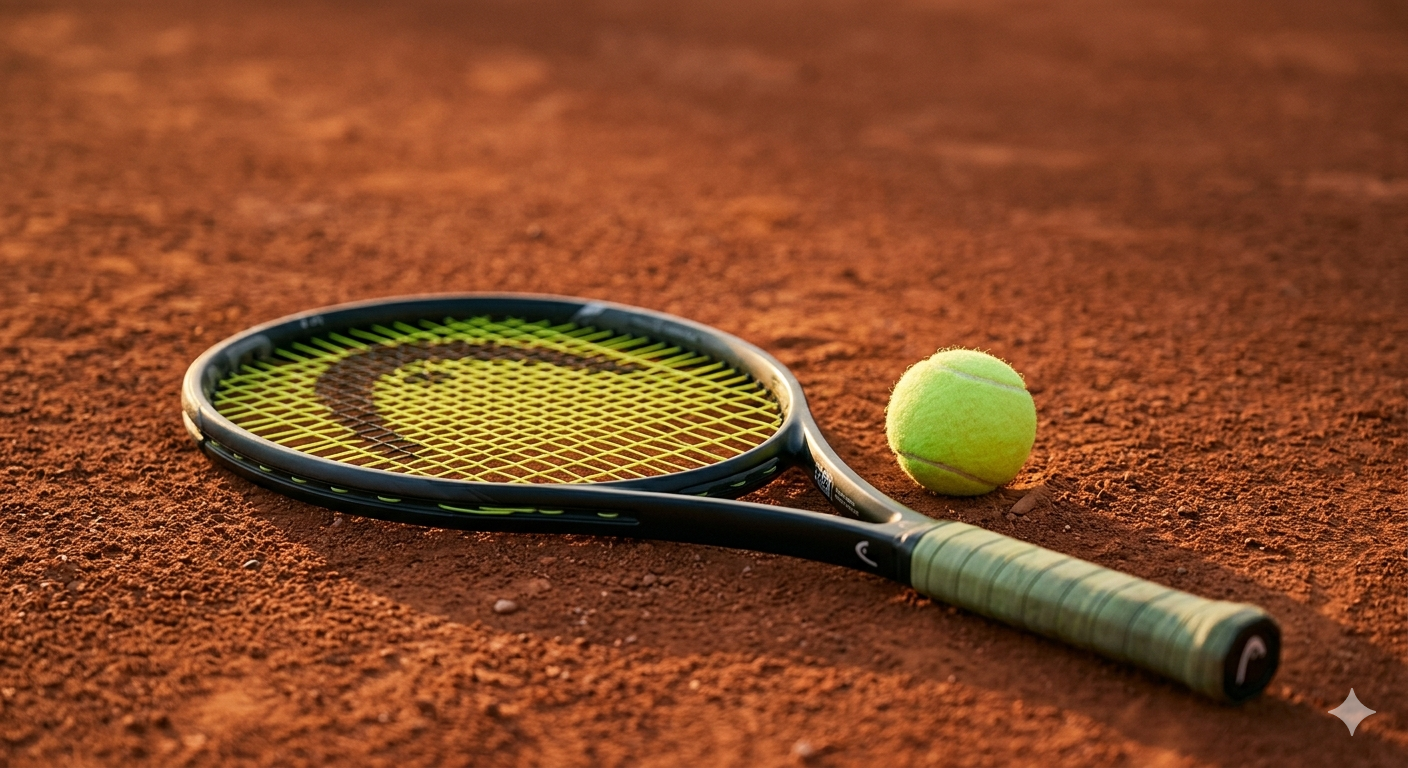
A beginner-friendly guide to the world’s most exciting individual sport
Sport & Lifestyle | June 2026
Imagine standing alone on a court. The sun is bright. The crowd is quiet. You have one ball, one racket, and one chance. This is the world of tennis — a sport that tests not just your body, but also your mind.
Tennis is one of the most popular sports in the world. Millions of people play it every year — from young children to people in their 70s. It is a sport for everyone. You can play it outside on grass, clay, or a hard surface. You can even play it inside. All you need is a racket, a ball, and someone to play with.
But tennis is much more than hitting a ball back and forth. It has a long and interesting history. It has amazing athletes. It has unforgettable moments. And it has lessons that you can use in everyday life. In this article, we will explore all of that — in easy English that anyone can understand.
Where Did Tennis Come From?
Tennis is an old sport, but not as old as you might think. The modern game started in England in the 1870s. A man named Walter Clopton Wingfield created a version of the game in 1873. He even gave it a strange name: “Sphairistike.” That is a Greek word, and nobody could say it! So people quickly started to call it “lawn tennis” instead.
Before that, people in France and England played an older game called “real tennis” or “royal tennis.” This game was very different — it was played inside a special building with unusual walls and no standard rules. Only rich people played it because the buildings were expensive.
The new outdoor game became very popular very fast. In 1877, the first Wimbledon championship took place in London, England. Only men could play at first, but women joined in 1884. Today, Wimbledon is still the most famous tennis tournament in the world.
- The word “tennis” probably comes from the French word tenez, which means “hold” or “receive.”
- The first Wimbledon had only 22 players and 200 people in the crowd.
- Today, Wimbledon has over 500,000 visitors every year!
How Do You Play? The Basic Rules
Tennis is played between two players (called singles) or between two teams of two players each (called doubles). The goal is simple: hit the ball over the net so that your opponent cannot hit it back.
The scoring system in tennis is one of the most unusual things about the sport. Instead of counting 1, 2, 3, tennis uses a special system: Love, 15, 30, 40, Game. The word “Love” means zero points. Nobody is completely sure why, but one popular idea is that it comes from the French word l’oeuf, which means “egg” — because a zero looks like an egg!
When both players have 40 points, we call it “deuce.” After deuce, one player must win two points in a row to win the game. The first point after deuce gives you an “advantage.” If you win the next point too, you win the game.
To win a set, you need to win six games — but usually with a difference of two games. And to win a match, you normally need to win two or three sets. So a full tennis match can take anywhere from 45 minutes to more than five hours!
Key Tennis Scoring Words
- Love — zero (0) points
- Deuce — when both players have 40 points (it is a tie)
- Advantage — when one player needs just one more point to win after deuce
- Set — a group of games (you usually need to win 6)
- Match — the full competition between two players (made of sets)
The Serve — Where Everything Starts
Every point starts with a serve. The player who serves stands behind the baseline (the back line of the court) and hits the ball into a specific area on the other side. If the ball does not go into the correct area, it is called a fault. You get two chances to serve. If you miss both, it is a double fault and you lose the point.
A great serve is very powerful. Professional players can serve at over 200 kilometres per hour. The fastest serve ever recorded was hit by Sam Groth from Australia — 263.4 km/h (163.7 mph). That is faster than most cars on a motorway.
The Four Grand Slams: The Biggest Tournaments
In professional tennis, the four most important tournaments are called the Grand Slams. Winning all four in a career is a great achievement. Winning all four in the same year — called a Calendar Grand Slam — is almost impossible. Only a few players have ever done it.
| Tournament | Location | Month | Surface |
|---|---|---|---|
| 🇦🇺 Australian Open | Melbourne, Australia | January | Hard court |
| 🇫🇷 French Open (Roland Garros) | Paris, France | May–June | Clay |
| 🇬🇧 Wimbledon | London, England | June–July | Grass |
| 🇺🇸 US Open | New York, USA | August–September | Hard court |
Each tournament has its own special character. Wimbledon is the oldest and most traditional — players must wear mostly white clothes there. The French Open is played on clay, which is a slow surface and makes rallies much longer. The Australian Open is famous for its extreme heat, where temperatures can reach 40°C (104°F).
- The prize money at each Grand Slam is usually over $50 million in total.
- The longest match in Grand Slam history lasted 11 hours and 5 minutes — over three days!
- That match was between John Isner and Nicolas Mahut at Wimbledon in 2010. The final set score was 70–68.
The Greatest Players of All Time
Tennis has produced some extraordinary athletes. The sport has had many great champions over the decades, but a few names stand above the rest.
Roger Federer — The Artist
Many people consider Roger Federer the most beautiful player to ever hold a racket. The Swiss champion made tennis look easy and elegant. His movements on the court were smooth and graceful, like a dancer. He won 20 Grand Slam singles titles during his career and was the world’s number one player for 310 weeks in total. He retired from professional tennis in 2022, but people still watch his old matches online every day.
“I always wanted to be a tennis player. I never dreamed of being world number one, I just wanted to play tennis.” — Roger Federer
Rafael Nadal — The Fighter
If Federer was the artist, Rafael Nadal was the warrior. The Spanish player never gave up — ever. He was famous for winning points that seemed impossible. His greatest success was on clay courts, especially at the French Open, which he won an incredible 14 times. His powerful forehand shot was one of the most dangerous weapons in tennis history. Nadal retired in 2024 after winning 22 Grand Slam titles.
Novak Djokovic — The Machine
Novak Djokovic from Serbia became the player with the most Grand Slam titles in history — 24 in total, more than any other man. He is incredibly consistent, meaning he almost never makes mistakes. His ability to return even the fastest serves is extraordinary. He is also famous for his mental strength: when he is losing, he often finds a way to win.
Serena Williams — The Queen
On the women’s side, Serena Williams is widely considered the greatest player of all time. She won 23 Grand Slam singles titles and was world number one for many years. What makes her story even more inspiring is that she and her sister Venus grew up in a difficult neighbourhood in California, USA. Their father taught them tennis on public courts that anyone could use for free. From those free public courts, Serena became the best in the world.
“I really think a champion is defined not by their wins but by how they can recover when they fall.” — Serena Williams
The Different Surfaces — Why They Matter
One thing that makes tennis special is that the surface of the court changes the game completely. A player who is excellent on grass might struggle on clay. This means that players need to be very adaptable — able to change their game for different situations.
Grass Courts 🟢
Grass is the oldest surface and the fastest. The ball moves quickly and stays low after it bounces. Players who serve very well usually prefer grass because their serves are harder to return. Wimbledon is the most famous grass tournament.
Clay Courts 🟠
Clay is the slowest surface. The ball bounces high and players have more time to reach it. Rallies — exchanges where both players hit the ball many times — are longer on clay. It requires a lot of physical fitness. Rafael Nadal dominated clay for many years.
Hard Courts 🔵
Hard courts are the most common surface in the world. They are consistent — the ball always bounces in the same way, which makes it easier to predict. However, hard courts are tough on players’ bodies, especially their knees and feet.
Tennis and Mental Health: The Battle in Your Head
One of the most important — and often forgotten — aspects of tennis is the mental side of the game. Tennis can be incredibly stressful. You are alone on the court. There is no team to help you. When you make a mistake, only you are responsible.
In recent years, many tennis players have started to talk openly about mental health. In 2021, Naomi Osaka withdrew from the French Open, saying that press conferences were bad for her mental health. This was very brave and started an important conversation around the world.
Sports psychologists now work with most professional tennis players. They teach techniques like controlled breathing, positive self-talk, and how to focus on the present moment. Here are a few tips that tennis players use:
- Breathe between points. Take a slow, deep breath to calm your mind.
- Forget the last point. Whether it was good or bad, it is gone. Focus on the next one.
- Talk to yourself kindly. Shouting at yourself after a mistake makes things worse.
- Look at your racket strings. Many players do this to refocus their attention.
Why Should You Start Playing Tennis?
It Is Great Exercise
Tennis is a full-body workout. You run, jump, reach, and swing. A one-hour game of tennis can burn between 400 and 600 calories. It is good for your heart, your legs, your arms, and even your brain — because you have to think and react very quickly.
It Is a Social Sport
Tennis is a wonderful way to meet new people. You can join a local club, take lessons, or just find a friend to hit with. Many tennis clubs have social events and competitions for players of all levels.
You Can Play at Any Age
One of the best things about tennis is that you can start at any age and continue for your whole life. There are tennis competitions for players over 70 years old! Many doctors recommend it for older adults because it is not too hard on the body.
It Teaches Life Skills
When you play tennis, you learn patience, discipline, and how to deal with failure. You will miss shots. You will lose games. But you learn to try again. These lessons are useful far beyond the tennis court — in school, at work, and in relationships.
Unforgettable Moments in Tennis History
Wimbledon 2008: Federer vs. Nadal
Many people call this the greatest tennis match ever played. Roger Federer and Rafael Nadal played for nearly five hours in the Wimbledon final. The match was interrupted twice by rain. The light became so bad that it was almost dark when Nadal finally won. Federer, who had won five Wimbledons in a row, cried after the match. Even Nadal looked sad — because the match was so hard and so beautiful that both players felt the emotion deeply.
Australian Open 2017: Federer’s Comeback
Roger Federer was 35 years old and had not won a Grand Slam for five years. Many people thought his best days were finished. Then he came back and won the Australian Open, defeating his old rival Nadal in a five-set final. Federer cried again — but this time from happiness.
US Open 2021: Emma Raducanu’s Impossible Dream
Emma Raducanu was an 18-year-old British player who had never played in a Grand Slam main draw before. She entered the US Open as a qualifier — meaning she had to win three extra matches just to enter the main tournament. She then won all ten of her matches without losing a single set. Nobody in tennis history had ever done anything like that before.
Tennis Around the World
Tennis is truly a global sport. It is played in almost every country. The biggest tennis nations include the United States, Spain, Switzerland, Serbia, Australia, France, and Germany. But the sport is growing fast in Asia too — especially in China and South Korea.
One of the most important team competitions in tennis is the Davis Cup (for men) and the Billie Jean King Cup (for women). These competitions bring together players from different countries to represent their nation. Tennis is also an Olympic sport — it was part of the first modern Olympics in 1896, removed for many decades, and returned in 1988.
- Over 87 million people play tennis regularly around the world.
- Tennis is played in more than 200 countries.
- The professional tour holds tournaments on 6 continents.
- The youngest world number one ever was Martina Hingis, who reached the top at just 16 years old.
Final Thoughts: A Sport for Life
Tennis is not just a game. It is a world full of stories, emotions, history, and lessons. From its beginnings on English lawns in the 1870s to the modern era of global superstars, tennis has grown into one of the world’s great sports.
Whether you want to play it yourself, watch it on television, or just learn more about it, tennis has something to offer everyone. It teaches us about perseverance — continuing to try even when things are difficult. It shows us that one person, with enough preparation and belief, can achieve extraordinary things.
So next time you see a tennis court in your city, stop for a moment. Watch the players. Listen to the sound of the ball hitting the racket. Maybe, just maybe, you will pick up a racket yourself. After all, every great player started exactly where you are right now — at the very beginning.
The ball is in your court. 🎾
📚 Vocabulary List (A2–B1)
- court — the place where you play tennis
- rally — when both players hit the ball back and forth many times in one point
- baseline — the line at the very back of the tennis court
- forehand — a shot hit with the front of your racket hand
- backhand — a shot hit with the back of your racket hand
- ace — a serve that the opponent cannot touch at all
- break — when you win a game while your opponent is serving
- qualifier — a player who has to win extra matches to enter the main tournament
- consistent — always performing at a similar level without many mistakes
- perseverance — continuing to try hard even when something is very difficult