
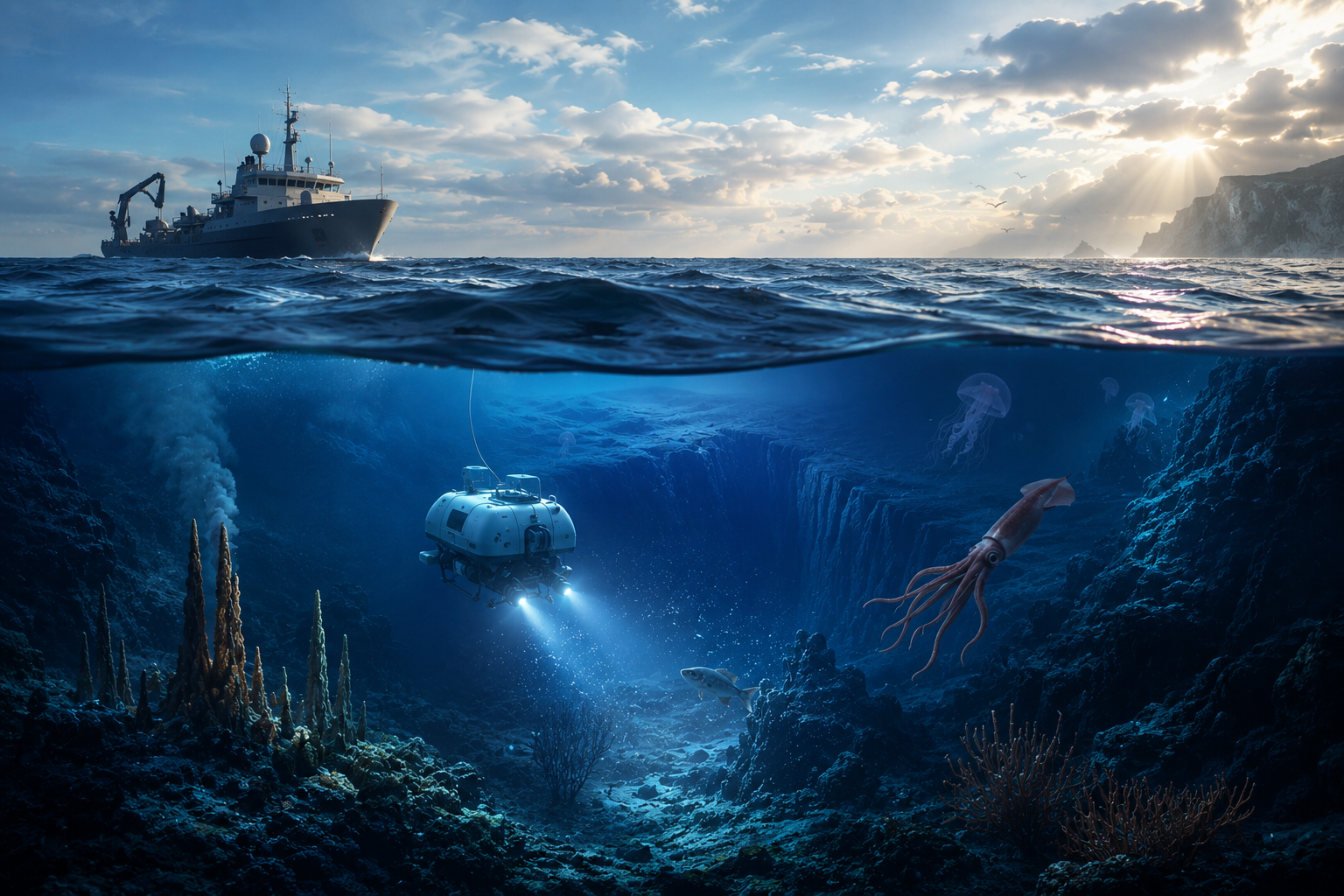
Here is a strange fact: we have better maps of the surface of Mars than we have of the bottom of our own ocean. Humans have walked on the Moon since 1969, but only a handful of people have ever traveled to the deepest point of the sea, the Challenger Deep in the Mariana Trench. The ocean covers more than seventy percent of our planet and holds about ninety-seven percent of all the water on Earth, yet more than eighty percent of it has never been mapped, observed, or explored in any detail. Why do we know so little about something so close to home?
The Challenger Deep: Earth’s Final Frontier
The deepest known point in the ocean is the Challenger Deep, located in the Mariana Trench in the western Pacific. It lies about 10,935 meters below the surface. To put that in perspective, if you placed Mount Everest at the bottom of the Challenger Deep, its peak would still be more than two kilometers underwater.
Only a few crewed vehicles have ever reached this depth. In 1960, Jacques Piccard and Don Walsh made the first descent in a vessel called the Trieste. It took more than fifty years before anyone returned. In 2012, film director James Cameron piloted a submarine called Deepsea Challenger to the bottom alone. In 2019, explorer Victor Vescovo went even further, diving to the Challenger Deep multiple times in a vessel called Limiting Factor and discovering new species along the way. Each of these missions proved how difficult, expensive, and dangerous deep-sea exploration really is.
A Dark and Crushing World
Below two hundred meters, sunlight cannot reach the water anymore, so this region, called the “midnight zone,” is completely dark. Pressure also increases fast: at the Challenger Deep, it reaches over 1,086 bars, more than one thousand times the pressure at sea level. This kind of pressure would instantly crush a normal submarine, and even a small mistake in engineering can be deadly. In 2023, the world was reminded of this danger when the Titan submersible, which was diving toward the wreck of the Titanic, suffered a catastrophic failure at depth.
Because of these extreme conditions, humans have physically explored a tiny fraction of the seafloor in detail. Most underwater maps we have today come from sonar readings taken by ships on the surface, not from actual visits by humans or robots.
Creatures That Seem Impossible
Every year, scientists discover hundreds of new marine species, and many of them look like they belong in a science fiction film. The anglerfish uses a glowing light on its head to lure prey through the darkness. The giant squid, which can grow longer than a school bus, was not filmed alive in its natural habitat until 2012. Near hydrothermal vents, scientists have found “yeti crabs” with hairy claws and tube worms that can grow over two meters long, living without any sunlight at all.
Hydrothermal vents are cracks in the ocean floor where volcanically heated water escapes, sometimes at temperatures above 370 degrees Celsius. Instead of sunlight, the bacteria living there get their energy from chemicals like hydrogen sulfide, through a process called chemosynthesis. This was one of the biggest discoveries in biology of the twentieth century, because scientists had always believed that life needed sunlight to survive.
Researchers estimate that more than two-thirds of all ocean species have not yet been identified. We have actually named and classified more species of beetles than every species living in the sea combined, even though the ocean is far larger than any patch of land.
Mountains, Canyons, and Hidden Landscapes
If you could remove all the water from the ocean, you would see one of the most dramatic landscapes on Earth. The Mid-Ocean Ridge, an underwater mountain chain, stretches for about 65,000 kilometers around the globe, making it the longest mountain range on the planet, far longer than the Andes and the Rockies combined. There are canyons deeper than the Grand Canyon, such as the Zhemchug Canyon near Alaska, and thousands of underwater volcanoes, some of which are still active.
Most of these features have never been photographed closely or studied in person. Ships use sonar to send sound waves to the ocean floor and measure how long they take to return, which creates a rough map, but the resolution is often too low to see small details clearly. To truly understand these landscapes, scientists need to send cameras and robots down, which is a slow and costly process.
Why Ocean Exploration Matters
Some people ask why we should spend money exploring the ocean when there are so many problems on land. However, the ocean is directly connected to human survival. Tiny ocean plants called phytoplankton produce an estimated fifty percent of the oxygen we breathe, more than all the rainforests on Earth combined. The ocean also absorbs roughly a quarter of the carbon dioxide humans release and around ninety percent of the extra heat trapped by climate change. Without the ocean, our planet would already be far too hot for humans to live comfortably.
The deep sea might also hold answers to major scientific questions. Some organisms living near hydrothermal vents can survive extreme heat and pressure, and scientists are studying their unique proteins to develop new antibiotics and cancer treatments. Other researchers believe that hydrothermal vents are similar to the conditions where life on Earth first began, nearly four billion years ago, so studying them could help explain our own origins.
New Technology, New Discoveries
Ocean exploration is changing fast thanks to new technology. Autonomous underwater vehicles, or AUVs, can now travel alone through deep water for weeks at a time, collecting data without a human pilot. Remotely operated vehicles, known as ROVs, let scientists on a ship control cameras and robotic arms thousands of meters below the surface in real time. Even satellites in space are helping researchers estimate the shape of the seafloor by measuring tiny changes in the height of the ocean surface, caused by the gravity of underwater mountains.
In 2017, an international project called Seabed 2030 was launched with one clear goal: to create a complete, high-resolution map of the entire ocean floor by the year 2030. Before this project began, less than ten percent of the seafloor had been mapped in detail. If Seabed 2030 succeeds, it will be one of the greatest scientific achievements in human history, and it will completely change how we understand our own planet.
An Ocean of Questions
The ocean has shaped human life for thousands of years, yet it continues to surprise even the scientists who study it most closely. Every expedition into the deep sea seems to raise more questions than it answers. What other creatures are swimming in the darkness of the Challenger Deep right now? What secrets are hidden inside canyons and mountain ranges that no human has ever seen?
Perhaps the most exciting part of ocean exploration is that nobody knows what will be found next. The next great discovery about our planet may not come from outer space at all. It might be waiting quietly, somewhere deep beneath the waves, in the part of Earth we understand the least.