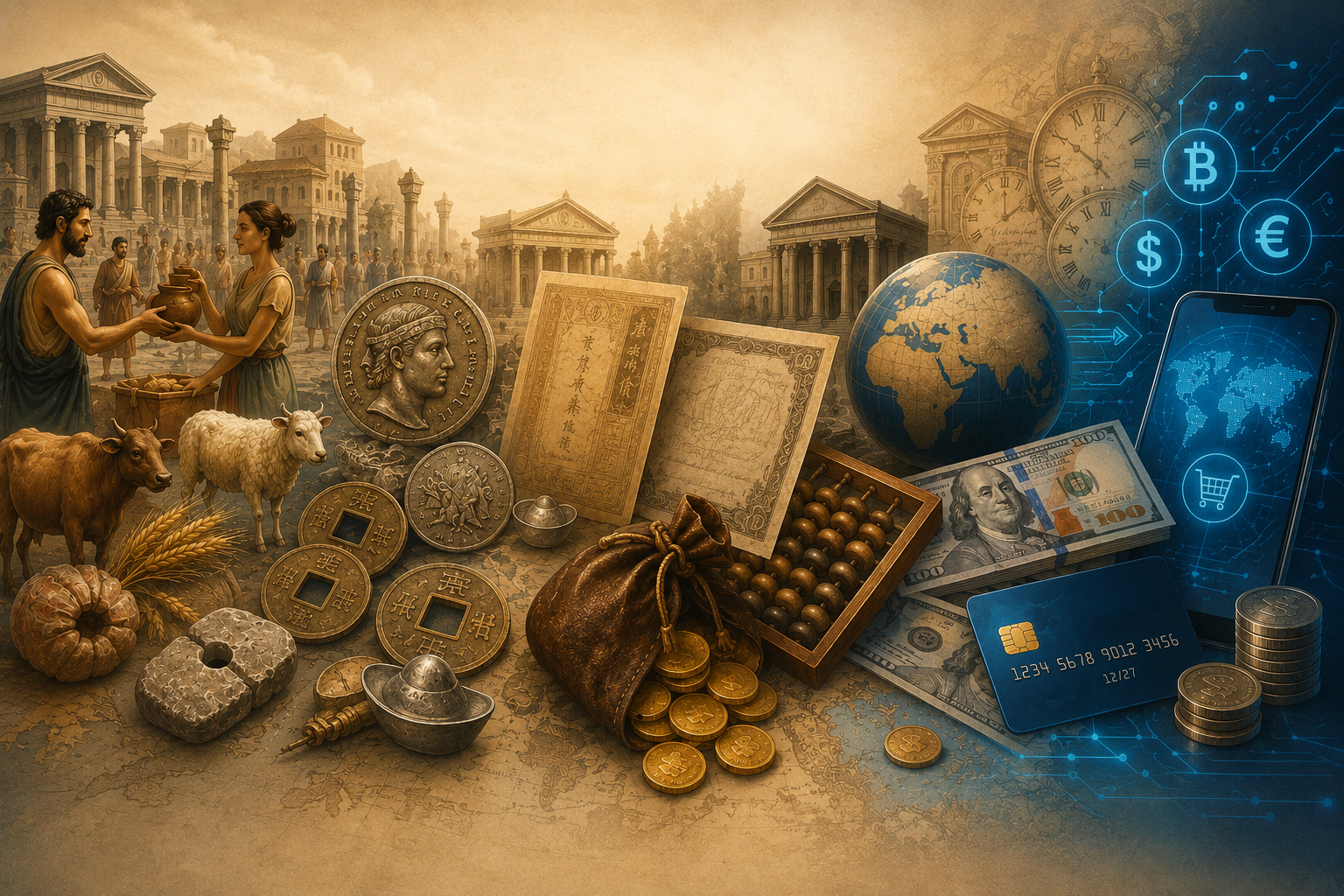
From trading goats to tapping your phone — how humans invented money, how it developed over thousands of years, and what forces shape it today.
🕒 Introduction: why do we need money?
Imagine you want to buy a pair of shoes. You go to a shop, pay, and walk out. Simple. But for most of human history, buying things was not simple at all. People had to find creative ways to exchange what they had for what they needed.
Money solved this problem. Today, we use it every single day — to pay for food, transport, education, and entertainment. But money was not always like this. Its story is long, fascinating, and still continuing.
🐐 Before money: the barter system
Thousands of years ago, people did not use money. Instead, they traded goods and services directly. A farmer might give ten fish to a carpenter, and the carpenter would build a table. This system is called barter.
Barter worked in small communities where people knew each other. But it had a serious problem called the “double coincidence of wants.” This means: you must find someone who has exactly what you need AND wants exactly what you have. If you had fish but needed shoes, you had to find a shoemaker who also wanted fish — at the same moment. This was very difficult and time-consuming.
Some early societies used special objects instead of barter: shells, beads, feathers, or even large stones. These were early forms of money. They worked because everyone in the community agreed they had value.
Did you know? On the island of Yap in the Pacific Ocean, people used giant stone discs as money. Some discs were over 3 metres wide and weighed 4 tonnes. They were too heavy to move, so people just remembered who owned each stone!
🪙 The first metal coins
Around 600 BC, people in the kingdom of Lydia (in modern-day Turkey) made the first standardised metal coins. These coins were made of electrum — a natural mixture of gold and silver. Each coin had the same shape and weight, and the king’s image was stamped on it. This showed the coin was official and could be trusted.
The idea spread very quickly. Greek and Persian merchants adopted coins, then the Romans built one of the largest coin-based economies in history. In China and India, metal coins developed independently around the same time.
Why was metal so good for money? It was durable (it did not rot like food), divisible (you could have large and small coins), portable (easy to carry), and scarce (not everyone could make it). These four qualities — durable, divisible, portable, scarce — are still the qualities we look for in good money today.
“A coin is just a piece of metal — but shared trust makes it powerful.”
Quick Facts:
- ~600 BC: First official coins made in Lydia, Turkey
- 30+: Currencies used in the Roman Empire at its peak
- 700 AD: Paper money appears in Tang dynasty China
📄 Paper money and the birth of banks
Metal coins solved many problems, but they were heavy. Merchants who travelled long distances had to carry bags of coins — which was dangerous and uncomfortable. A new solution appeared in China during the Tang dynasty (around 700 AD).
Wealthy merchants began leaving their coins with trusted shops. The shop gave them a paper note that said: “This note is worth 500 coins.” The merchant could travel with only the note and exchange it for coins later. These notes were called jiaozi, and they are considered the world’s first paper money.
By the 1200s, the Mongol ruler Kublai Khan made paper money the official currency across China. When the Italian explorer Marco Polo visited China, he was amazed. In Europe at that time, people still used heavy metal coins.
European countries gradually adopted paper money in the 1600s and 1700s. Governments created central banks — for example, the Bank of England was founded in 1694. These banks printed paper notes that were backed by gold. This system was called the gold standard: every note could theoretically be exchanged for a fixed amount of gold.
In the 20th century, most countries left the gold standard. Today, paper money has value simply because governments declare it legal and citizens trust it. Economists call this fiat money — from the Latin word meaning “let it be done.”
Did you know? During the First World War, many countries printed huge amounts of money to pay for the war. In Germany after the war, inflation became so extreme that people used wheelbarrows full of banknotes just to buy bread.
📱 Cards, digital money, and cryptocurrency
In the 20th century, money changed again. Banks began offering credit cards in the 1950s. Customers could buy things and pay the bank later. In the 1980s and 1990s, debit cards allowed people to pay directly from their bank accounts.
The internet brought online banking and online shopping. Today, many people never touch physical cash. They pay by phone, smartwatch, or a tap of a card. Money is now mostly numbers in a computer system.
In 2009, a new type of money appeared: Bitcoin. It was the first cryptocurrency — digital money that uses complex mathematics to work securely without a central bank or government. Since then, thousands of cryptocurrencies have been created. Some people see them as the future of money; others think they are too risky and unstable.
Many governments are now developing their own digital currencies, called CBDCs (Central Bank Digital Currencies). China’s digital yuan is already being tested by millions of people. The future of money may be completely digital.
🔍 What affects the value of money?
Money is not static. Its value changes constantly, and many different forces influence it:
- Inflation: When prices rise, money buys less. A coffee costing $1 in 2000 may cost $4–5 today. Central banks try to keep inflation low and stable.
- Government policy: Governments decide how much money to print and how to spend it. Too much money in the economy causes inflation; too little can cause recession.
- Global trade: Countries import and export goods. When demand for a country’s products is high, its currency usually becomes stronger.
- Technology: New payment systems and cryptocurrencies are changing what money looks like and how it moves around the world.
- Interest rates: Central banks raise or lower interest rates to control the economy. Higher rates make borrowing more expensive and can slow inflation.
- Trust: The most important factor of all. Money only works because people believe in it. Without trust, even gold loses its value.
✨ Conclusion
The history of money is really a history of human cooperation and trust. We moved from trading goats and fish, to carrying metal coins, to paper notes backed by gold, to typing numbers into a phone app. Each change happened because people needed something more convenient, more reliable, or more secure.
One thing has stayed the same across thousands of years: money is only valuable because people agree it is. A coin, a banknote, or a number on a screen — none of these has real physical value on its own. What gives money power is the trust that millions of people place in it every day.
As technology continues to develop, money will keep changing. But the idea behind it — a shared tool that helps us exchange things fairly — will always remain.
📚 Key Vocabulary
- Barter: to exchange goods or services without money.
- Currency: the system of money used in a country.
- Standardised: made the same size, weight or quality everywhere.
- Inflation: a general rise in prices over time.
- Central bank: a national bank that controls a country’s money supply.
- Gold standard: a system where currency is backed by a fixed amount of gold.
- Fiat money: money that has value because the government says so, not because of gold.
- Cryptocurrency: digital money using encryption, with no central authority.
- Exchange rate: how much one currency is worth in another currency.
- Interest rate: the cost of borrowing money, set by a central bank.