
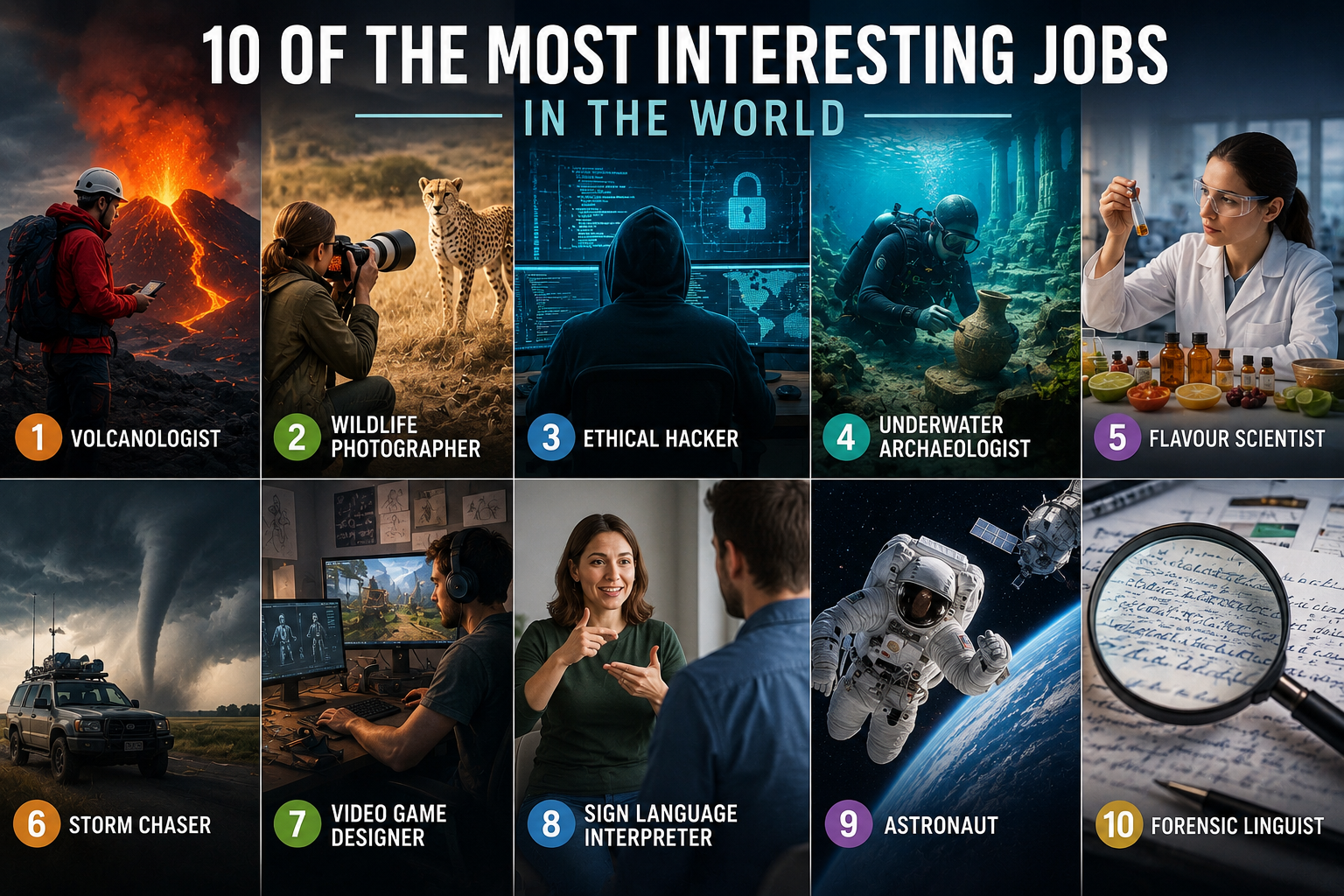
1. Volcanologist
Field: Earth Science
Imagine standing next to a river of hot lava. For most people, this is a nightmare. For a volcanologist, it is just another Tuesday at work.
Volcanologists are scientists who study volcanoes. They measure the temperature of lava, collect gas samples, and watch how the ground moves before an eruption. Their work helps communities know when a volcano might explode, so people can leave in time and stay safe.
Some volcanologists work in laboratories. Others go directly to active volcanoes in places like Iceland, Hawaii, and Indonesia, wearing special protective suits to stay as safe as possible.
To become a volcanologist, you usually need to study geology or earth science at university. The job can be dangerous, but it is also deeply rewarding. Because of this work, thousands of lives are saved every year.
2. Wildlife Photographer
Field: Art & Nature
You wake up at 4 in the morning. You walk quietly into a cold forest. You wait for three hours without moving. Then, suddenly, a rare snow leopard walks in front of your camera. Click. You got the shot.
Wildlife photographers travel to remote parts of the world — jungles, deserts, oceans, and mountains — to take pictures of animals in their natural environment. Their images appear in magazines, documentaries, and educational books. They show people what nature really looks like.
This job requires a lot of patience. Animals do not follow a schedule. A photographer might wait many days just to take one perfect photo. They also need a lot of technical knowledge about cameras and lighting.
But when the picture is right, it can change how millions of people feel about the natural world — and inspire them to protect it.
3. Ethical Hacker
Field: Technology
Companies pay some people to break into their computer systems. No, this is not a crime — these are ethical hackers, also called “white-hat hackers” or penetration testers.
Their job is to find problems in computer security before criminals can find them. They try to enter systems without permission, but only because the company asked them to do it. When they find a weak point, they write a report and explain how to fix it.
Ethical hackers need strong knowledge of programming, networks, and computer systems. Many learned how to hack as a hobby, and then turned that knowledge into a career. Today, this is one of the most in-demand jobs in the technology world.
It is a job that requires you to think like a criminal — but use your skills to help and protect people instead.
4. Underwater Archaeologist
Field: History & Exploration
The ocean floor is full of history. Ships, cities, and ancient objects have been lying under the water for hundreds — sometimes thousands — of years. Underwater archaeologists dive deep to find and study them.
These scientists use scuba diving equipment and sometimes small submarines to explore wrecks and sunken structures. They take photographs, draw maps, and carefully collect objects to bring to the surface. Every item they find tells a story about how people lived in the past.
One famous example is the Titanic, which lies about 3,800 metres below the Atlantic Ocean. Underwater archaeologists have explored and documented it in great detail. But there are thousands of other sites around the world, many of which have not yet been discovered.
This job combines two exciting worlds: the mystery of history and the adventure of the deep sea.
5. Flavour Scientist
Field: Food & Science
Have you ever wondered who invents the taste of a new flavour of crisps or a new type of soft drink? That person is probably a flavour scientist, also known as a flavorist.
Flavour scientists work in laboratories and test kitchens, creating and improving the tastes and smells of food products. They combine different chemicals and natural ingredients to produce a specific flavour — for example, the taste of strawberry, coffee, or barbecue sauce.
This is a very scientific job. Flavorists need to understand chemistry, biology, and how our senses work together. They also need to know the safety rules about which ingredients are safe to eat.
It takes years of training, but at the end of it, you literally design how the world tastes.
Most flavorists work for large food companies or for specialised flavour companies that sell their products to food manufacturers around the world.
6. Storm Chaser
Field: Meteorology
When a dangerous tornado is coming, most people run away. Storm chasers drive towards it.
Storm chasers are scientists and researchers who follow severe weather events — tornadoes, hurricanes, and large thunderstorms — to collect data. They drive specially equipped vehicles and use instruments to measure wind speed, air pressure, and temperature inside a storm. This information helps meteorologists create better weather forecasts and warning systems.
Storm chasing became more well-known after the 1996 film Twister, and in recent years many people have seen storm chasers share videos on social media. But in real life, it is not just an exciting hobby — it is serious science that requires training and experience.
The job is clearly dangerous. But the data collected by storm chasers has helped save many lives by improving our ability to predict when and where storms will hit.
7. Video Game Designer
Field: Creative Technology
Playing video games is fun. But have you ever thought about what it is like to make them?
Video game designers create the rules, worlds, characters, and stories inside games. They decide how a player can move, what the goals are, and what makes the game enjoyable. They work closely with artists, programmers, and writers to bring a game to life.
A game designer needs to understand what makes things fun. Why does a player want to continue playing? What is the right level of difficulty — not too easy, not too hard? These are questions that game designers think about every day.
The video game industry is now worth more than the film industry and the music industry combined. It employs millions of people worldwide — artists, storytellers, musicians, and engineers all work together to create the games people love.
It is one of the few jobs where your childhood hobby — sitting in front of a screen playing games — can become your professional training.
8. Sign Language Interpreter
Field: Language & Communication
Most people think of interpreters as people who translate spoken languages — from French to English, for example. But sign language interpreters work in a very different and special way.
They translate spoken language into sign language and sign language into spoken words, in real time. They work in courtrooms, hospitals, schools, concerts, television studios, and conferences. Their work allows deaf and hard-of-hearing people to participate fully in public life.
Sign language interpreters must have excellent concentration. They cannot pause or stop to think — everything happens live. They also need to understand not just the words, but the tone, meaning, and emotion behind them.
There are hundreds of different sign languages in the world — for example, American Sign Language (ASL) is completely different from British Sign Language (BSL). Each has its own grammar and structure.
This job requires empathy, quick thinking, and years of practice. It also makes a real difference in the lives of the people it serves every single day.
9. Astronaut
Field: Space & Exploration
Perhaps no job on this list is more famous — or more difficult to get — than being an astronaut.
Astronauts travel to space on rockets and live on space stations, sometimes for six months or more at a time. While in space, they conduct scientific experiments, perform repairs on the outside of the station (in spacewalks), and learn how the human body changes without gravity.
Getting selected to become an astronaut is extremely competitive. Space agencies like NASA or ESA receive thousands of applications but choose only a small number of candidates every few years. Candidates usually need degrees in science or engineering, flying experience, and must pass very difficult medical and physical tests.
Living in space is not comfortable — the food is different, sleeping is strange, and you cannot take a normal shower. But looking at the Earth from a window in orbit is an experience no other job can give you.
With companies like SpaceX and Blue Origin now sending people to space, this career is slowly becoming less rare — but it remains one of the most extraordinary things a human being can do.
10. Forensic Linguist
Field: Language & Law
Language can solve crimes. That is the basic idea behind forensic linguistics — one of the most unusual careers on this list.
Forensic linguists analyse the way people use language to help in legal situations. For example, they might study a threatening letter to identify who wrote it based on word choice, spelling mistakes, and sentence structure. They might also analyse a recording of a phone call to check if the voice belongs to a specific person. Or they might help a court understand whether someone fully understood a contract they signed.
Every person uses language in a slightly different and unique way — like a fingerprint made of words. A forensic linguist’s job is to read those fingerprints.
This field sits between the worlds of linguistics, psychology, and criminal justice. It is a relatively new field, but it has already helped solve many serious crimes. Most forensic linguists have an advanced university degree in linguistics and work with police departments, law firms, or as independent experts in court cases.
The world is full of remarkable work
From the bottom of the ocean to outer space, from a laboratory mixing tastes to a forest waiting for a wild animal — the jobs on this list show that work can be so much more than sitting at a desk. Many of these careers require years of study and hard work to reach. But they also offer something that most ordinary jobs do not: the feeling that every single day is genuinely different and genuinely matters.
Whatever your interests are — science, art, language, technology, or adventure — there is probably a career out there that will surprise you. The only question is: which one is yours?