
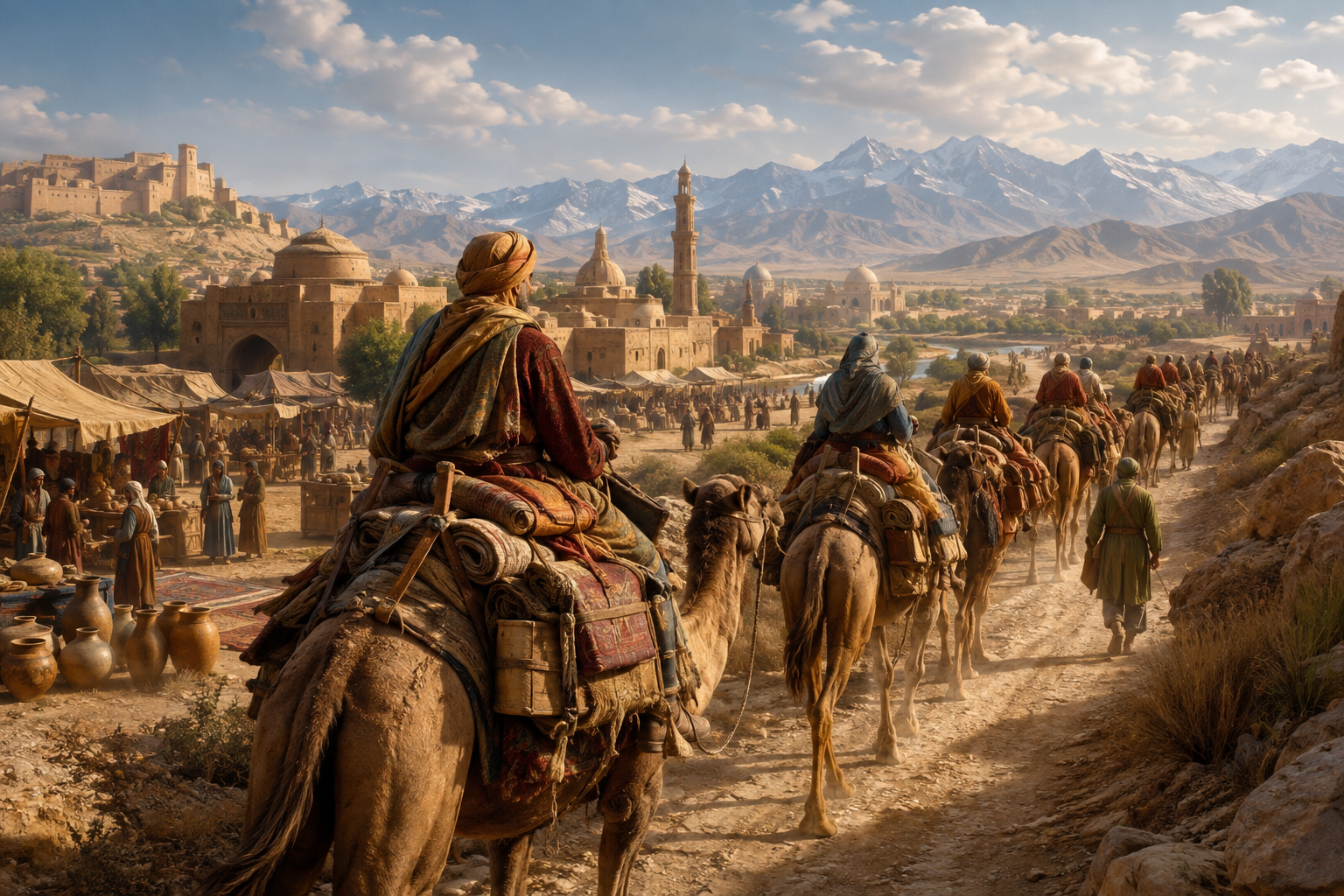
Long before container ships crossed oceans or fibre-optic cables carried data beneath the sea, a camel caravan trudging through the Taklamakan Desert was already linking the fortunes of empires thousands of miles apart. A merchant in Xi’an could not have named the city of Rome, yet the silk he sold might end up draped across a senator’s shoulders there within a year or two. This is the paradox at the heart of the Silk Road: a network stitched together not by any single government or grand design, but by the accumulated self-interest of countless traders, none of whom ever saw the whole picture. It was, in every meaningful sense, the first globalization — and its legacy still shapes the world we live in.
A Network, Not a Road
The name itself is somewhat misleading. There was no single “Silk Road,” paved and signposted, running neatly from China to the Mediterranean. Rather, the term describes a sprawling web of overland and maritime routes that emerged gradually from the second century BCE onward, linking the Han Dynasty in the east to the Roman Empire, the Persian Gulf, and eventually East Africa and Western Europe. Caravans threaded through the oases of Central Asia — Samarkand, Bukhara, Kashgar — cities that grew wealthy simply by sitting at the right crossroads. Few merchants travelled the entire distance themselves; instead, goods were passed along in relay, changing hands dozens of times, accumulating stories, mark-ups, and cultural residue at every stop.
This relay structure is worth dwelling on, because it explains something counterintuitive about the network’s resilience. No single collapse — a war in Persia, a change of dynasty in China, a plague outbreak in Central Asia — could sever the entire system, because no single actor controlled it. Trade simply rerouted, slowed, or shifted to alternative paths, including the maritime corridors that carried spices and porcelain around the Indian Ocean. The Silk Road, in other words, behaved less like a fragile supply chain and more like a living organism, adapting to disruption rather than shattering under it.
More Than Silk
Silk gave the network its name, largely thanks to nineteenth-century European geographers who coined the term retrospectively, but the actual cargo was staggeringly diverse. Spices, precious stones, glassware, paper, gunpowder, tea, and ceramics moved in one direction or another, while ideas travelled just as readily as objects. Buddhism spread from India into China along these same routes, carried not by armies but by monks and merchants who happened to share a road. Papermaking technology, invented in China, eventually reached the Islamic world and then Europe through this same diffuse channel, transforming how knowledge itself could be recorded and preserved.
Perhaps most strikingly, the Silk Road facilitated an exchange of diseases as well as goods — a grim preview of how interconnected trade networks would later spread pathogens across the globe. The Plague of Justinian in the sixth century and, centuries later, the Black Death that devastated medieval Europe both likely travelled along these same commercial arteries, hitching a ride with fleas, rodents, and the merchants who unknowingly transported them. Globalization, then as now, cut both ways: it enriched societies even as it exposed them to risks that recognised no border.
Middlemen Who Made History
No discussion of the Silk Road is complete without the Sogdians, an Iranian-speaking people from Central Asia who, for several centuries, functioned as the network’s indispensable middlemen. Based in city-states such as Samarkand, the Sogdians built diaspora communities strung out along the entire route, from the Chinese capital of Chang’an to the borders of Byzantium. They were not merely opportunistic traders; they developed a shared commercial language, standardised weights and measures, and even a kind of proto-diplomatic etiquette that allowed business to continue despite shifting political alliances.
The Sogdians illustrate a broader truth about how the Silk Road actually functioned: it depended less on any single empire’s military might and more on trust networks that transcended political boundaries. A Sogdian merchant in seventh-century China might have more in common, commercially speaking, with a fellow Sogdian in Samarkand than with the Chinese officials who taxed his goods. This is a strikingly modern phenomenon — multinational communities whose loyalties and interests run parallel to, rather than through, the states they inhabit.
The Mongol Peace and Its Aftermath
If the Silk Road had a golden age, it arrived, somewhat counterintuitively, under the Mongols. The thirteenth-century conquests of Genghis Khan and his successors are remembered, understandably, for their brutality, yet the empire they built also produced the so-called Pax Mongolica — a period in which a single political authority, however ruthless, controlled enough territory to guarantee relative safety along the trade routes. Merchants could travel from the Black Sea to Beijing under one administrative umbrella, and it was during this era that figures like Marco Polo made their celebrated journeys, returning to Europe with tales that many contemporaries dismissed as fantasy.
This unified oversight did not last. As the Mongol empire fragmented in the fourteenth century, the political stability that had underwritten trade began to erode, and the routes grew increasingly perilous. Combined with the rise of maritime alternatives — European sailors eventually found sea routes around Africa to Asia, bypassing the overland network entirely — the classical Silk Road gradually declined. Yet its underlying logic, the notion that distant economies could be woven together through sustained exchange, never disappeared. It simply migrated to new infrastructure: ships, and later, railways and aircraft.
Echoes in the Modern World
It is tempting to view the Silk Road as a historical curiosity, safely confined to museum exhibits and academic monographs. But its structural DNA is recognisable in contemporary globalization. Consider how modern supply chains, much like Silk Road caravans, rely on countless intermediaries who never interact directly with the final consumer. Consider how the spread of the internet, like the spread of Buddhism or papermaking centuries earlier, has carried both extraordinary benefits and unforeseen vulnerabilities across borders that governments struggle to control. Even the term “globalization” itself, often treated as a distinctly modern coinage, describes a phenomenon that merchants trudging through the Taklamakan Desert would have recognised instantly, even without a word for it.
China’s contemporary Belt and Road Initiative makes this continuity explicit, invoking the historical Silk Road as both branding and blueprint for a new era of infrastructure investment stretching across Asia, Africa, and Europe. Whatever one makes of its geopolitical ambitions, the initiative’s very name is a tacit admission that the ancient network still holds explanatory power for how the modern world connects, trades, and occasionally clashes.
What the Silk Road ultimately demonstrates is that globalization was never a single event, inaugurated by a particular treaty or invention. It has been, since at least the second century BCE, an ongoing and recurring human project — one built not by any grand architect, but by generations of traders, monks, diplomats, and opportunists who simply kept moving, kept trading, and kept discovering that the world was smaller, and more interdependent, than anyone had assumed.